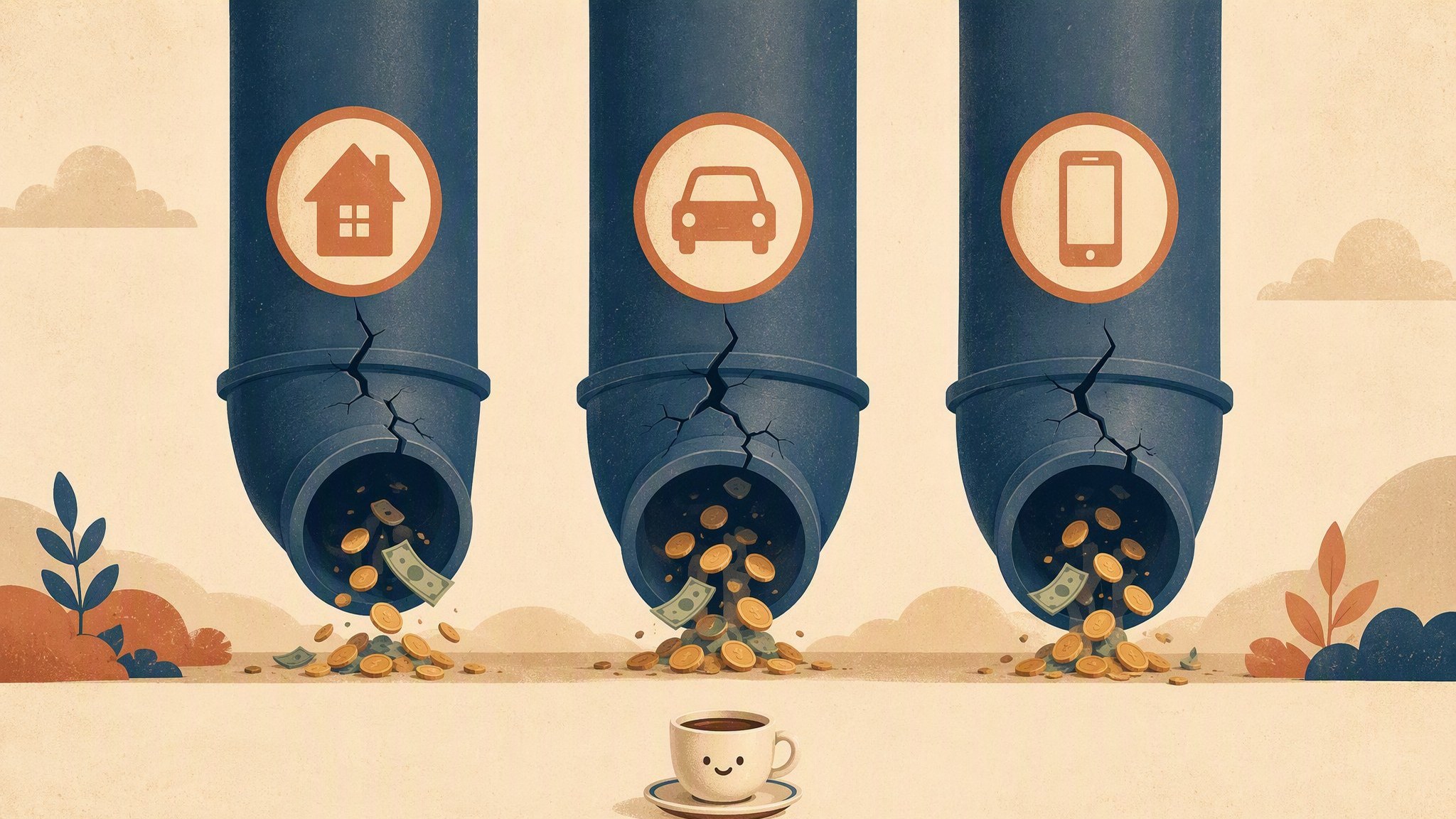
The Latte Factor Is Dead: What Actually Moves Your Finances Now
Skipping the coffee was always bad math. The modern money leaks are structural, automatic, and invisible — and fixing three of them beats a decade of denial.
Somewhere in a desk drawer there’s a version of you from years ago who tried the classic advice: skip the daily coffee, save five dollars, retire on the difference. It lasted eleven days. The coffee came back, the guilt stayed, and the savings account never noticed either way. Here’s the thing nobody told that earlier version of you: the math was never going to work. Five dollars a day is real money — roughly $1,800 a year — but it was never the leak that mattered, and the decade of financial advice built on denying yourself small joys mostly produced joyless people with the same savings rate. The leaks that actually sink household finances are bigger, quieter, and far less satisfying to lecture about. They’re also, conveniently, much easier to fix — because most of them only need to be fixed once.
Why the Latte Math Failed
The problem was never the coffee
The latte factor had one good insight buried in a bad frame. The good insight: small recurring expenses compound. The bad frame: that the path to financial stability runs through daily micro-denial. It doesn’t, for three reasons.
First, the willpower economics are terrible. Denying yourself a small pleasure is a decision you must remake every single day, forever — and daily decisions are exactly the kind humans are worst at sustaining. A structural change, like negotiating a bill or raising a savings transfer, is made once and executes itself. Second, the scale is wrong. Housing, transportation, insurance, and debt service dominate household budgets; the difference between a manageable and an unmanageable financial life lives in those categories, not in the café. Third, denial breeds rebellion. Anyone who’s ever attempted a strict budget recognizes the pattern: three weeks of austerity followed by a compensating blowout that erases the savings and adds regret.
The modern approach flips the order: fix the big automatic things first, build the savings mechanism into the structure of the month, and then let the coffee be coffee. Resources from the Consumer Financial Protection Bureau lean the same direction — their tools focus on cash-flow awareness and automatic saving, not on scolding small purchases.
Leak One: The Subscriptions You Forgot You Had
The monthly drip, audited
If there is a true heir to the latte factor — a small-leak category that actually matters now — it’s subscriptions. The business model of half the modern economy is the recurring charge: streaming services, apps, cloud storage, subscription delivery boxes, premium tiers, gym memberships with a gravitational field. Each is small. The aggregate, for a typical household, routinely lands between one and three hundred dollars a month — several lattes’ worth every single day, invisible because it never asks for a decision.
The audit takes thirty minutes, once. Pull the last two months of bank and card statements and list every recurring charge. For each one, three questions: Did I use this in the last month? Would I sign up for it again today at this price? Is there a cheaper tier I’d barely notice? The rule that makes this work: cancel first, resubscribe later if you genuinely miss it. Almost nothing gets resubscribed, which tells you what it was worth.
Two habits keep the leak sealed: an annual subscription audit (calendar it), and a personal rule that every new subscription gets a one-month trial mindset — if it’s not earning its place by day thirty, it goes. Subscriptions are sold as trivial because each one is. The leak is in the plurality.
Leak Two: The Loyalty Tax on Big Bills
Insurance, internet, and the price of never calling
Here’s a structural leak so reliable it has a name in the industry: price optimization. Insurance companies, internet providers, and mobile carriers have learned that existing customers don’t shop around — so rates quietly drift upward for the loyal, while the good prices go to new customers. The penalty for never calling typically runs to hundreds of dollars a year per bill.
The fix is unglamorous and astonishingly effective: an annual hour on the phone. Once a year, for each big recurring bill — auto and home insurance, internet, mobile plan — either get a competing quote or call and say you’re doing exactly that. A large share of the time, the retention department finds a discount that was somehow available all along. When they don’t, you switch, which is easier than it’s ever been.
The numbers make the case. An hour of calls that saves $40 a month is a $480-per-hour activity. There is no legal hourly activity most households can do that pays better. Yet almost nobody does it, because it requires a phone call, and modern life has trained us to tolerate almost any charge to avoid one. Calendar it with the subscription audit. Same day, every year. The Investor.gov resources from the SEC hammer a related point on the investing side: recurring fees that seem small — even a fraction of a percent — compound into enormous sums over decades. Whether it’s a bill or a fund fee, recurring is the word to watch.
Leak Three: Debt Interest, the Silent Second Rent
The leak with a meter running
If subscriptions are a drip and loyalty taxes are a seep, high-interest debt is an open tap. A credit card balance at typical rates is among the most expensive money a household can carry — a $5,000 balance at 24% costs about $1,200 a year in interest alone, forever, until it’s gone. That’s not a latte. That’s a latte every weekday, plus another one every weekend, bought for a bank.
The hierarchy of fixes is well established. If you’re carrying card balances, that’s the emergency — not because of shame, but because of math: no savings account and essentially no investment reliably returns what the card charges, so paying it down is the highest-yield “investment” available to you. Strategies in descending order of cleverness: a balance-transfer offer if your credit qualifies (watch the transfer fee and the end date), a consolidation loan at a fixed lower rate, or simply the avalanche method — minimums on everything, every spare dollar at the highest-rate balance, roll the freed payment into the next one when it dies.
Two cautions worth the ink. First, beware the relief of consolidation without the behavior change — the cleared card that quietly refills is the classic sequel, and it’s worse than the original. Second, if the balances are large and the math can’t work on any realistic timeline, nonprofit credit counseling exists and is the sensible next step, not a defeat. The CFPB’s site maintains guides for evaluating those services without getting scammed by the for-profit imitators.
The Structure That Replaces Willpower
Pay-yourself-first, engineered
Once the big leaks are patched, the question becomes where the recovered money goes — and the answer has to be structural, because unassigned money evaporates. The mechanism that works, across essentially every income level and personality type, is the automatic transfer on payday.
The design is simple: the day income lands, an automatic transfer moves a set amount to a separate savings account — separate institution ideally, so it takes a day to get back, which is usually enough friction to protect it. Start with a number that feels almost too easy, even 1–2% of income. Increase it every few months, and route every raise, refund, and side-earning into it before lifestyle absorbs it. The behavioral finding behind this is one of the sturdiest in economics: people save what never arrives in checking. Money you see is money you spend; the system’s entire job is to make sure you don’t see it.
What the transfer builds first is the emergency fund — the buffer that separates a bad month from a crisis. The standard guidance is three to six months of essential expenses, which sounds impossible until the transfer has been quietly running for a year or two. Start with a $1,000 mini-fund as the first milestone; it’s enough to turn most car repairs from credit-card events into merely annoying events, and that alone changes a household’s financial weather.
Where the Coffee Fits Now
Spending loudly on what you love
With the structural work done, the philosophy of small spending changes completely. The question stops being “how do I cut everything?” and becomes “what do I actually love, and what’s just habit?” The coffee you genuinely savor — the ritual, the walk, the ten minutes of peace — is a bargain at almost any price. The one you drink while answering email and barely taste is waste at any price.
The practical version is a simple test: for your recurring small pleasures, ask whether you’d notice if it disappeared for a week. The ones you’d mourn, keep proudly and without arithmetic. The ones you wouldn’t notice, drop without ceremony. Most people find the list splits unevenly — a few real joys and a longer tail of defaults — and cutting the defaults doesn’t feel like denial because it isn’t. It feels like decluttering.
This is the sustainable middle the old advice never found: aggressive about the invisible, relaxed about the visible. A household that has fixed its big bills, killed its zombie subscriptions, crushed its expensive debt, and automated its savings can afford its pleasures outright. The coffee tastes better when it’s not carrying the whole weight of your financial anxiety, which it never deserved to do anyway.
The One-Hour-Per-Quarter System
Everything above, on a schedule
| When | Task | Time |
|---|---|---|
| This week | Subscription audit: list every recurring charge, cancel the zombies | 30 min |
| This month | Set up the automatic payday transfer to separate savings, however small | 15 min |
| Annually, calendared | Loyalty-tax calls: insurance, internet, mobile — quote or negotiate each | 60 min |
| Monthly, 5 minutes | Glance at statements for new recurring charges and rate creep | 5 min |
| If carrying card debt | Pick the payoff strategy, automate the payment above the minimum | 45 min, once |
| With every raise | Increase the automatic transfer before the raise reaches your lifestyle | 2 min |
Notice what’s absent: daily tracking, category envelopes, and any requirement to think about money more than an hour a quarter. The system is designed for people with lives. That’s the entire upgrade — thirty years of frugality advice, replaced by a calendar reminder and a couple of transfers, producing better results with a fraction of the misery.
The Two Big Rocks Nobody Wants to Discuss
Housing and transportation, briefly
Honesty requires mentioning the two categories that dwarf everything else: where you live and what you drive. Together they consume roughly half of a typical household budget, which means a modestly better decision in either one outweighs every other tactic in this article combined. The household that keeps the paid-off car three extra years has out-saved a decade of subscription audits. The housing choice that leaves breathing room — rather than maxing what a lender approves — determines whether every other financial habit is easy or impossible.
These aren’t frequent decisions, which is exactly why they deserve the most thought. You choose a car a handful of times per decade and a home even less; a few points of improvement at those moments out-earns years of vigilance elsewhere. The useful framing at the moment of decision: this choice will execute itself every month for years, like a subscription — negotiate it like one.
The Psychology That Makes Leaks Invisible
Why your brain doesn’t flag recurring charges
It helps to know why these leaks survive for years undetected. Humans notice payments, not charges — a payment is an event you perform, a charge is an event that happens to you. Handing over cash hurts; a number quietly changing on a statement doesn’t. The entire subscription economy is built on this asymmetry.
There’s also the optimism bias at signup: every trial starts with genuine intent (“I’ll use this constantly”) and converts, silently, into a default. And there’s plain friction asymmetry — signing up takes two taps, canceling takes a phone call or a five-screen maze. Companies A/B-test that maze, which tells you how much it’s worth to them.
Knowing the mechanism produces a useful personal rule: treat every recurring charge as guilty until audited. The statement review isn’t bookkeeping; it’s the moment the invisible becomes a decision again.
A Note for the Irregular Paycheck
The system with variable income
Everything above assumes a steady paycheck, and roughly a third of workers don’t have one. The mechanics adapt. The automatic transfer becomes a percentage rule instead of a fixed amount: every payment that lands, a set slice — even five percent — moves immediately, before it dissolves into the month. The emergency fund’s target stretches toward the six-month end, because for irregular earners it doubles as an income smoother. And the subscription audit matters more, not less: fixed monthly drains are most dangerous when income is least fixed.
The psychological shift is the same one, though: structure over vigilance. An irregular income can’t be white-knuckled day by day — the variance will win. It can be given rules that execute themselves, and rules don’t care whether this month’s check was fat or thin.
One more habit belongs in every version of the system, regular paycheck or not: the annual net-worth snapshot. Once a year, list what you own and what you owe, subtract, and write the number down next to last year’s. It takes twenty minutes, it requires no precision, and it answers the only question the daily noise obscures — is this working? Watching that number crawl upward for three consecutive years changes a person’s relationship with money more than any single tactic in this article, because it converts an abstract anxiety into a visible, winnable game.
This article is educational and is not financial advice; consider consulting a qualified financial professional about your specific situation. Sources referenced include the Consumer Financial Protection Bureau and Investor.gov (SEC). No affiliate links or sponsored content. External links verified live at publication, August 2026.