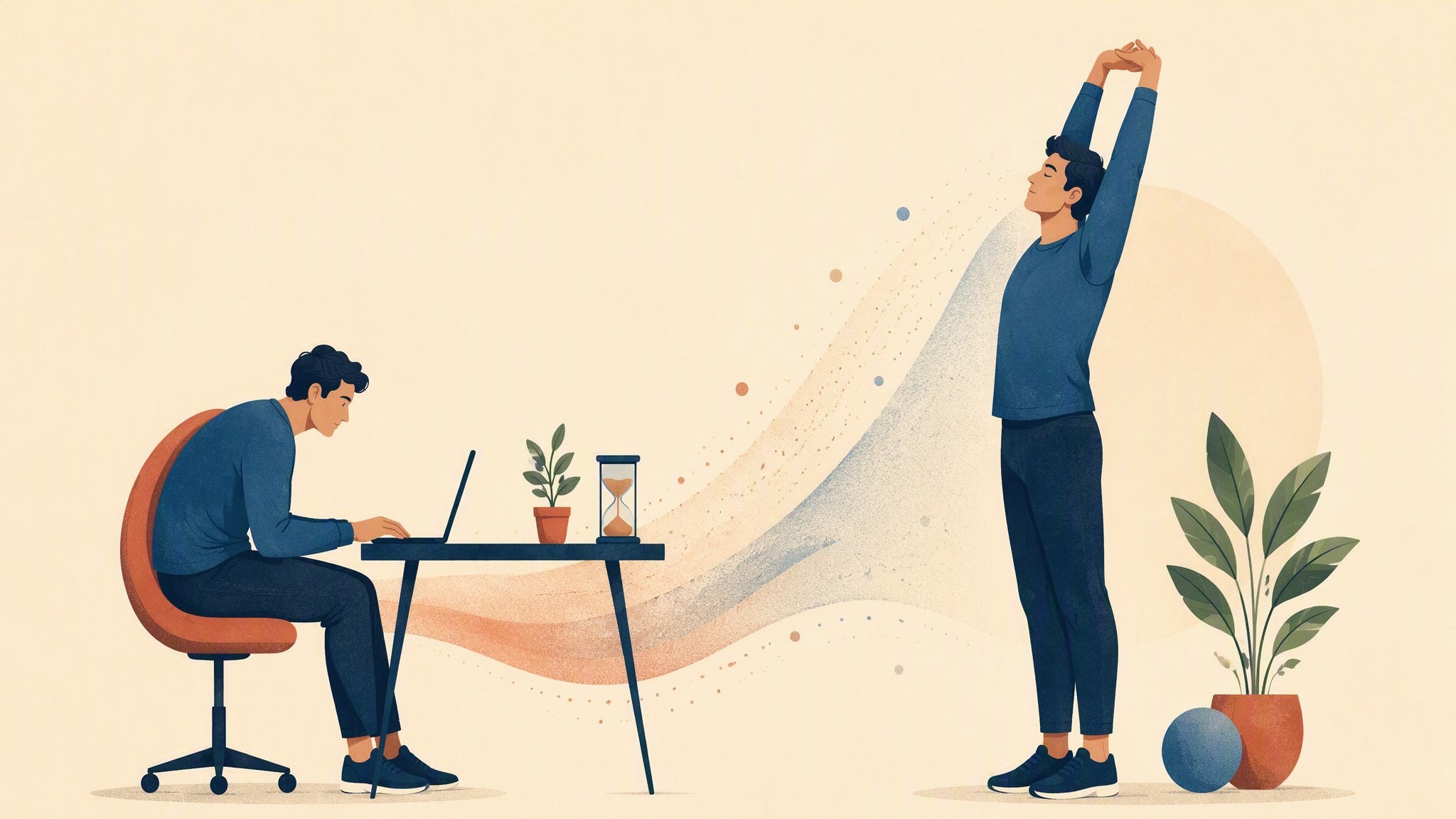
The Desk Body: What Sitting All Day Actually Does and How to Undo It
Eight hours in a chair leaves a signature: hips that won’t open, shoulders that live by your ears, a back with opinions. Here’s the map of the damage and the fifteen-minute daily repair job.
Stand up from your desk right now — really, do it — and notice what happens. The hips unfold a beat slowly, like a lawn chair with opinions. Something in the upper back announces itself. Your shoulders sit suspiciously close to your ears, and when you roll them back there’s a small chorus of clicks. That was one workday. Now multiply by a decade. The desk body isn’t an injury; it’s an adaptation — your body patiently reshaping itself to fit the shape you practice most. The encouraging news is that adaptation runs both ways, and the repair work is surprisingly cheap: minutes a day, no equipment, done badly at first and better within weeks.
What the Chair Actually Changes
A guided tour of the adaptations
Sitting isn’t passive. It’s a position your body actively remodels itself around, tissue by tissue. The tour, from the ground up:
Hip flexors. Seated, your hips are bent at roughly ninety degrees for hours at a stretch. The muscles at the front of the hip adapt to that shortened position — they don’t just rest short, they get short. Stand up and they resist lengthening, tilting the pelvis forward and handing the lower back a job it was never designed to do alone. This is why so much “back pain” is actually hip-flexor tightness with the bill sent elsewhere.
Glutes. Sitting is, mechanically, a long glute switch-off. Muscles that aren’t asked to work lose both strength and their connection to your movement patterns — the charming technical term is “gluteal amnesia.” When the glutes go quiet, the lower back and hamstrings pick up their share of hip extension, and they complain about it, constantly, in the language of aches.
Upper back and shoulders. Screens pull the head forward and the shoulders inward. The muscles between the shoulder blades lengthen and weaken while the chest muscles shorten. Over years this becomes the rounded, head-forward posture everyone recognizes and nobody chose. The neck muscles, holding up a head that’s drifting forward of its base, work overtime — ten or twelve pounds of skull becomes, in effective load, much more the further forward it sits.
The deeper stuff. Beyond muscles: circulation slows, and the post-meal blood-sugar handling is measurably worse when you sit through the hours after eating. Prolonged sitting is associated with cardiovascular and metabolic risk in ways that exercise alone doesn’t fully cancel. The WHO’s physical activity fact sheet is blunt about it: sedentary time is its own risk factor, separate from whether you also exercise.
The Uncomfortable Math: Exercise Doesn’t Fully Cancel Sitting
Why the morning gym session isn’t a pardon
This is the finding that surprises people most: an hour of exercise, while excellent, does not erase ten hours of unbroken sitting. The research on sedentary behavior shows that long uninterrupted sitting bouts carry risk even in people who meet the weekly exercise guidelines — the so-called “active couch potato” pattern.
The good news hiding in that finding is that the mitigation isn’t heroic. What breaks the risk is breaking the sitting — standing up, moving briefly, regularly. Studies comparing patterns suggest that interrupting sitting every 30 to 60 minutes with even two or three minutes of light movement substantially blunts the metabolic damage. You don’t need to exercise at your desk. You need to not be a statue at your desk.
This reframes the whole problem in a hopeful direction. The desk body has two parents — the position itself and the uninterrupted duration — and only one of them requires a gym to fix. The duration one requires nothing but a timer and a small amount of stubbornness.
The Interrupt Protocol
What to do every hour, in under three minutes
The first line of defense is the hourly interrupt. Not a workout — a state change. Here’s the minimal effective version, which takes about two minutes and can be done in business casual without attracting attention:
Stand and unfold (30 seconds). Stand, reach tall, breathe once or twice with a long exhale. It sounds ceremonial; it’s actually just telling your hips and spine that the seated chapter is paused.
Walk somewhere (60–90 seconds). Water, bathroom, a lap of the office or the house, stairs if they’re handy. Walking is the opposite of sitting for almost every tissue involved — hips extending, glutes firing, blood moving.
One mobility move (30 seconds). Rotate through a short list across the day: standing hip-flexor stretch (step one foot back, tuck the pelvis, feel the front of the hip open), doorway chest stretch, ten slow shoulder rolls, a gentle standing backbend with hands on your lower back. One per interrupt is enough; you’ll cover the whole map by evening.
The mechanism that makes this work isn’t the exercises — it’s the frequency. Set a timer. Fifty minutes of work, three minutes of movement, repeat. The CDC’s physical activity resources emphasize exactly this “move more, sit less, in whatever way works” framing, because the research keeps pointing the same direction: interruptions matter more than intensity for undoing the sitting itself.
The Fifteen-Minute Repair Session
The daily undo, move by move
The hourly interrupts keep the damage from compounding. The daily repair session starts reversing it. Fifteen minutes, once a day, no equipment. The sequence matters less than showing up, but here’s a well-worn order:
Couch stretch (2 minutes each side). The single highest-value move for desk workers. Kneel with one knee on the floor near a wall or couch, shin vertical behind you, other foot forward. Tuck the pelvis under — that’s the part everyone skips — and gently rise tall. The front of the hip will have a lot to say. Two slow minutes per side, breathing through it.
Glute bridges (2 sets of 12–15). On your back, feet flat, drive the hips up and pause at the top. This is wake-up call for the glutes — the pause at the top is where the reconnection happens. If it’s easy, single-leg it.
Doorway chest stretch (60–90 seconds). Forearm on a doorframe, elbow at shoulder height, step through gently until the chest and front shoulder open. This is the direct counter to the rounded-forward position.
Wall angels (8–10 slow reps). Back against a wall, arms in a goalpost shape, slide them overhead and back while keeping ribs down and arms near the wall. Humbling, excellent, and the best upper-back posture trainer that costs nothing.
Cat-camel and thoracic rotations (2 minutes). On all fours, slowly round and arch the spine, then add gentle rotations, threading one arm under and opening to the ceiling. The middle of the back — the part that stiffens into a plank from desk life — is built to rotate, and it needs the reminder daily.
Deep squat hold (1–2 minutes, accumulated). Hold onto a doorframe if needed and sit into a deep squat, heels down if they allow. It’s the resting position the chair replaced, and reclaiming it does quiet maintenance on ankles, knees, and hips all at once.
Strength: The Long-Term Insurance
Because stretching alone won’t hold the repairs
Mobility work opens positions; strength keeps them open. A muscle that’s long but weak is just a long weak muscle, and the body will drift back to its habitual shape under load. The repair program needs a strength component, and it can live entirely in two short sessions a week.
The desk body’s strength shopping list is predictable, because it’s the opposite of the sitting position: rows (band, dumbbell, or backpack full of books) to rebuild the upper back; hip hinges (learning to pick things up with your hips rather than your spine) to restore the glutes’ main job; some form of squat pattern; and carries — walking while holding something heavy — which train posture, grip, and core simultaneously with glorious simplicity.
The Physical Activity Guidelines for Americans recommend muscle-strengthening work at least two days a week for everyone, and desk workers should hear that as a minimum written specifically for them. Fifteen minutes of mobility daily plus two short strength sessions weekly will out-repair any stretch-only routine, and the whole program fits in the margins of a normal week.
Fix the Workstation, but Don’t Worship It
Ergonomics as supporting actor
Ergonomics matters, with a caveat: no chair, desk, or monitor arm has ever undone ten hours of stillness by itself. The perfect setup reduces strain; it does not create movement. Buy the basics, then stop shopping.
The basics, briefly. Screen at eye level so the head stops drifting forward. Keyboard and mouse close enough that the shoulders stay home rather than reaching. Feet supported, elbows near ninety degrees. A chair you can change positions in — because the research consensus, to the extent one exists, is that the best posture is the next posture. Variety beats perfection.
Standing desks deserve a specific note: they’re a useful tool and a terrible panacea. Standing still for eight hours is just sitting’s cousin — same stillness, different joint. If you have one, alternate: thirty to sixty minutes sitting, fifteen to thirty standing, and keep the hourly interrupts regardless. The movement was always the active ingredient.
The Week That Repairs a Desk Body
Everything assembled
| When | What | Time |
|---|---|---|
| Every work hour | Stand, walk briefly, one mobility move | 2–3 min |
| Daily (evening works well) | The repair session: couch stretch, bridges, doorway stretch, wall angels, rotations, squat hold | 15 min |
| 2× weekly | Short strength session: rows, hinges, squats, carries | 15–20 min |
| Daily, opportunistic | Walk after meals, stairs by default, calls on foot | Built in |
Total additional time: about twenty-five minutes on a workday, most of it in fragments small enough that no calendar will notice them. What you’re buying with that is not abstract. It’s the difference between a body that files complaints every evening and one that mostly doesn’t — between ending the workday feeling folded and ending it merely tired.
What to Expect and When
The honest timeline
The first changes arrive fast and feel small: less end-of-day stiffness within a week or two, mostly from the interrupts. The couch stretch, which begins as a negotiation, starts feeling almost pleasant around week three — that’s your hip flexors actually lengthening. Posture changes are slower, measured in months, and they’re maintenance-dependent: the desk keeps applying its pressure daily, so the repair has to become a standing practice rather than a six-week project.
Two cautions. If sitting has already produced real pain — persistent back pain, numbness, tingling down a leg or arm — that’s past the self-repair stage and worth a professional assessment before you stretch anything aggressively. And if you’re starting from zero, start smaller than the full program: interrupts this week, repair session next week, strength the week after. The desk body was built over years. Rebuilding it over months is not slow; it’s the only speed that works.
The Weekend Trap
Why Saturday doesn’t cancel Friday
A quiet failure pattern deserves its own warning: the week of strict sitting followed by the weekend of heroic activity. Five days as a statue, then a long hike, a hard ride, two hours of yard work. It feels like balance. Physiologically it’s closer to whiplash — an unprepared body suddenly asked for its maximum, which is precisely how weekend-warrior injuries happen.
The fix isn’t less weekend activity; it’s a floor under the weekdays. Even a reduced version of the interrupt protocol on workdays — three or four stand-ups instead of eight — keeps tissues prepared enough that Saturday’s ambitions are fun instead of orthopedic. Think of weekday movement as what makes weekend movement safe.
There’s a subtler version of the same trap in weekday evenings: work all day, sit all evening. The desk body gets built at the desk but it gets cured everywhere — and an evening on the couch is, to your hip flexors, just overtime.
Signals You’re Making Progress
What improvement actually feels like
Progress in repair work is quiet, and knowing the markers keeps you going when the mirror has nothing to say. Watch for these: the morning stiffness taking less time to shake off. Standing up from a long sit without the two-stage unfolding process. The couch stretch position becoming reachable without the mild panic. Noticing you’re standing taller in a shop-window reflection and not immediately slumping when you notice. Fewer end-of-day complaints from the lower back and neck.
Each of these is small. Together, over months, they’re the whole point: a body that fits your life instead of one that’s been quietly fitted to your chair.
Making the Interrupts Actually Happen
The reminder problem, solved four ways
Everyone agrees with the hourly interrupt in principle; almost nobody does it, because work swallows the hours whole. The people who succeed at this don’t have better memories — they have better triggers.
The external timer. A repeating fifty-minute alarm, an app, or a smartwatch nudge. Crude, effective, and the default starting point. The trick is that the alarm means “stand now,” not “note the time and continue.”
The water loop. Keep a modest glass, not a giant bottle, at your desk. Small glass means frequent refills; refills mean walking; the water itself means bathroom trips. Hydration engineering, doubling as a movement schedule.
Task-based triggers. Attach movement to events that already recur: every sent report, every ended meeting, every completed call is a thirty-second stand. Events don’t forget the way timers get muted.
The social contract. A colleague or a household member who also stands when the timer goes. Shared interrupts survive the way solo ones don’t, mostly because skipping requires an awkward explanation.
This article is educational and is not medical advice; if you have persistent pain, numbness, or existing conditions, consult a qualified professional before starting new exercises. Sources referenced include the World Health Organization, the CDC, and the U.S. Physical Activity Guidelines. No affiliate links or sponsored content. External links verified live at publication, August 2026.