Exercise Snacks: The Case for Ten-Minute Workouts (and Why the Science Is on Your Side)
The old rule said exercise doesn’t count unless it hurts for an hour. The current guidelines say every minute counts — and that changes everything for busy people.
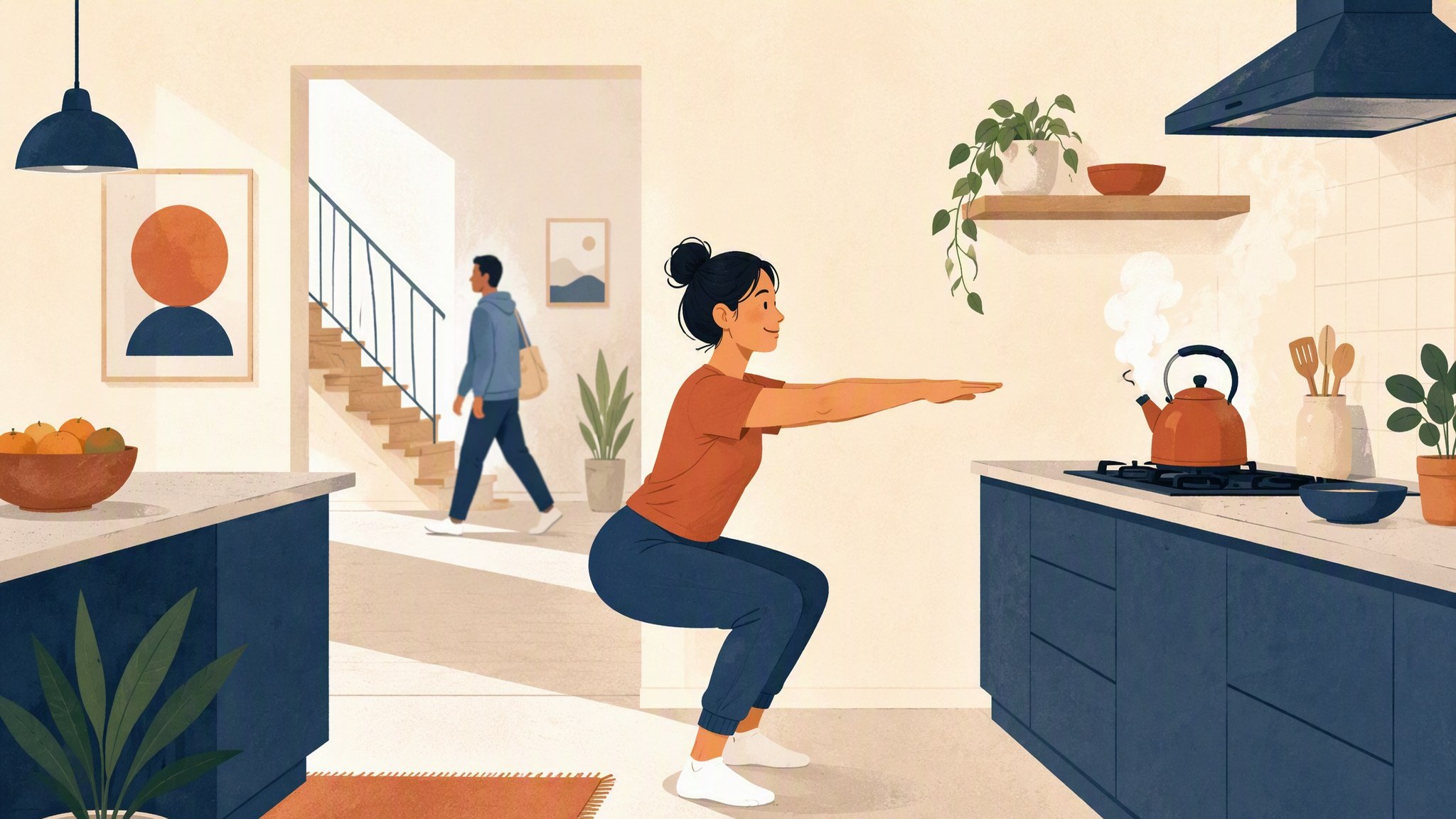
The kettle is on. You’ve got maybe four minutes before it boils. Somewhere in the back of your mind is the familiar voice noting — again — that you haven’t done a “real workout” since last Tuesday, or possibly last month. Here’s what that voice doesn’t know: in the time it takes the water to heat, you could accumulate exercise that the official guidelines fully recognize. Not a consolation prize. Not “better than nothing,” with a sigh. Legitimate, guideline-counted, health-producing movement, done in your kitchen, in your regular clothes. Welcome to the world of exercise snacks — and to the quiet death of the all-or-nothing workout.
The Rule Change Nobody Announced
What the guidelines actually say now
For years, the standard advice came with a fine-print condition: physical activity counted toward your weekly total only if it lasted at least ten minutes at a stretch. That single clause did enormous damage. It told everyone with a fragmented schedule that their scattered five-minute efforts were worthless, so they stopped bothering.
The clause is gone. The current U.S. Physical Activity Guidelines dropped the ten-minute requirement, and the language now is as plain as it gets: some activity is better than none, and every minute counts toward the weekly targets. Those targets, for adults, are 150 to 300 minutes of moderate-intensity activity a week (or 75 to 150 vigorous), plus muscle-strengthening work on two days. The World Health Organization’s physical activity fact sheet carries essentially the same numbers for the rest of the world.
Do the arithmetic with the new rule and the picture flips. Ten minutes here, seven minutes there, a brisk twelve-minute walk after lunch — five small deposits a day, five days a week, and you’re at the guideline minimum without ever once “working out.” That’s not a loophole. That’s the actual design.
Why Short Bouts Work
The physiology of the snack
The skepticism is understandable: how can ten minutes compare to an hour? Partly it’s a framing error. Nobody serious claims ten minutes equals fifty. The claim is that ten minutes counts, that short bouts accumulate, and that for many health outcomes the total dose matters more than the packaging.
The mechanisms are well documented. Brief bouts of movement interrupt prolonged sitting, which is independently harmful in ways that even a daily gym session doesn’t fully offset — the person who exercises for an hour and then sits for ten is not the metabolic picture of health that one workout suggests. Sprinkling movement through the day keeps blood sugar regulation, circulation, and fat metabolism ticking over rather than stalling out between workouts.
There’s also the intensity advantage. Short efforts are easier to do hard. A ten-minute bout can be brisk enough to genuinely challenge your heart and muscles in a way most people won’t sustain for forty-five. And research on very short “exercise snacks” — think a few one-minute bursts of stair-climbing spread through the day — has found meaningful improvements in cardiorespiratory fitness in previously sedentary adults. Small, repeated, doable: it’s a training principle, not a compromise.
What Counts (and What Doesn’t)
Calibrating “moderate” without a lab coat
The guidelines’ intensity language confuses everyone, so here’s the field version. Moderate intensity means you can talk but not sing — a brisk walk, casual cycling, carrying groceries with intent, active housework done at a pace. Your heart rate is up, you’re slightly warm, but a conversation still works. Vigorous intensity means talking is reduced to short phrases — running, fast cycling, hard rowing, taking stairs two at a time.
The handy conversion: vigorous minutes count double. Seventy-five vigorous minutes equals the 150-minute moderate target. So a ten-minute hard stair session buys you twenty minutes of weekly credit.
And the CDC’s overview of physical activity basics is worth bookmarking for the breadth of what qualifies. Dancing in the kitchen counts. Raking counts. Playing tag with your kids counts. The guidelines don’t care about your outfit, your location, or whether you broke a sweat photogenic enough for social media. They care about minutes at intensity, accumulated however you can accumulate them.
The Snack Menu
Ten-minute bouts that don’t require a gym, a mat, or a change of clothes
The best exercise snack is the one that fits the crack in your schedule you actually have. Here’s a menu organized by where the cracks usually appear.
The morning wake-up (5–10 minutes). A short mobility flow plus one strength circuit: bodyweight squats, countertop push-ups, a plank. Two rounds. It won’t transform your physique by itself, but it starts the day with a deposit and — less obviously — makes later snacks more likely. Momentum is a real mechanism.
The workday interrupts (2–10 minutes each). Stairs, taken briskly, two at a time if your knees allow. A walk around the block between meetings. Desk-adjacent squats and calf raises while a file downloads. The target here isn’t fitness per se — it’s breaking up sitting. Set a timer for every hour or two if you have to; the reminder matters more than the specific activity.
The lunch walk (10–15 minutes). The highest-value snack on the menu for most people. Brisk, outdoors, immediately after eating if possible — post-meal walks have a notably good effect on blood sugar. This one habit, five days a week, is roughly half your weekly moderate target by itself.
The evening finisher (7–10 minutes). A short strength circuit while dinner cooks or the bath runs. Alternate: squats, push-ups against the counter, a hip hinge (pick something heavy up properly, repeatedly), some kind of row if you have a band or a sturdy bag. Two or three rounds, resting as needed.
The stealth version (all day). Parking farther away, taking the stairs by default, walking during phone calls, carrying rather than carting. These don’t feel like exercise, which is the point — they’re background minutes that count anyway.
The Strength Question
Because two days a week of muscle work is also in the guidelines
Walking snacks cover the aerobic half of the guidelines beautifully, but there’s that second requirement people skip: muscle-strengthening activity on two or more days a week. It tends to get skipped because “strength training” sounds like a place you have to go. It isn’t.
A ten-minute strength snack, twice a week, meets the spirit of the requirement for most otherwise-sedentary adults. The formula is boring and effective: one lower-body move (squats, lunges, step-ups on a stair), one push (push-ups at whatever incline lets you do eight to fifteen), one pull (band rows, or heavy-grocery carries if that’s what you have), and one brace (plank or similar). Rotate through for ten minutes. Done.
The stakes here are higher than aesthetics. Muscle mass and strength are among the best predictors of how well your later decades go — independence, fall risk, metabolic health. The ten-minute version won’t build a powerlifter, but it will absolutely build and maintain the functional reserve that determines whether stairs stay easy at seventy. Small deposits, long horizon.
Building the Habit: Anchors, Not Alarms
How snacking becomes automatic
The failure mode for exercise snacks is the same as for everything else: relying on remembering. The fix is anchoring — attaching each snack to an event that already happens, so the trigger is built in.
After I start the coffee, I do the morning circuit. After lunch, I walk. When a meeting ends early, I take the stairs once before sitting back down. The “after X, I do Y” structure works because it borrows an existing habit’s reliability instead of asking your willpower to generate a new one from nothing. Within a few weeks, the anchor fires automatically and the snack stops feeling like a decision.
Two more rules that keep the system alive. First, the floor is one snack, not five: a day with a single five-minute walk is a success by the new rules, because it maintains the streak and counts real minutes. All-or-nothing thinking is how this dies. Second, track the week, not the day. The guidelines are weekly targets. A bad Wednesday is irrelevant if the week adds up — which is also exactly how you should judge it.
What Snacks Can’t Do
An honest boundary
Integrity check: exercise snacks are a foundation, not the whole building. If your goals are specific — run a 10K, build visible muscle, get meaningfully faster — you need longer, progressive sessions, and snacks are the scaffolding around them rather than the substitute.
There’s also a dose-response reality. Going from nothing to 150 accumulated weekly minutes produces a large health return. Going from 150 to 300 produces more. The curve never flattens to zero. So once snacks have made movement automatic and painless, some people find they’ve accidentally built the habit platform they never had — and adding one or two longer sessions a week stops feeling impossible. That’s the usual sequence, and it’s the reverse of how most people fail: they start with the hour-long ambition, skip it for three weeks, and quit. Start with the snack. Let it grow if it wants to.
A Sample Week, Snack-Style
What hitting the guidelines actually looks like
| Day | Snacks | Minutes banked |
|---|---|---|
| Monday | 10-min morning circuit + 12-min lunch walk + stairs twice | ~26 |
| Tuesday | 15-min lunch walk + 10-min evening strength | ~25 |
| Wednesday | 10-min lunch walk + kitchen dance break + stair trips | ~20 |
| Thursday | 10-min morning circuit + 12-min lunch walk | ~22 |
| Friday | 15-min lunch walk + 10-min evening strength | ~25 |
| Saturday | 30-min walk with a friend (one long snack) | ~30 |
| Sunday | Gardening, house projects, whatever the day brings | ~20 |
That’s roughly 168 minutes — past the guideline minimum, including two strength days, without a single session longer than half an hour and without once putting on workout clothes. It’s not a fantasy schedule; it’s an ordinary week with the dead spaces put to work.
The Psychology of the Small Win
Why ten minutes succeeds where an hour fails
The deepest advantage of the snack approach isn’t physiological — it’s behavioral. The hour-long workout carries a brutal success threshold: it requires a free hour, the right clothes, the right place, enough energy, and no childcare emergencies. Miss any one condition and the day’s exercise is zero. Do that math across a month of real life and the zero-days pile up fast.
Ten minutes has almost no failure conditions. Rain doesn’t cancel a kitchen circuit. A late meeting doesn’t cancel a stair trip. Bad moods don’t cancel ten minutes the way they cancel sixty. The behavioral science on habit formation is consistent on this point: frequency beats intensity for building automaticity. The person who moves a little every day becomes “someone who moves daily” within weeks; the person attempting three heroic sessions a week is still, psychologically, “someone trying to start exercising,” often for years.
There’s an identity shift hiding in here too. Each snack is a small vote for the kind of person you are, and votes accumulate into self-image faster than you’d expect. People who snack their way into movement routinely report the same strange moment a few months in: they catch themselves taking the stairs without deciding to. That’s the goal state — movement as default, not as project.
Common Objections, Honestly Answered
The three pushbacks everyone has
“Ten minutes isn’t enough to matter.” For winning races, correct. For health, wrong — the dose-response research is clear that the steepest benefits come precisely at the low end, in the move from nothing to something. The gap between sedentary and lightly active is where lives are most changed.
“I won’t see results, so why bother.” Depends which results you’re watching. The mirror is the slowest feedback channel there is. Energy, sleep quality, mood, and afternoon focus all respond within weeks, sometimes days. People who track how they feel rather than how they look are the ones still moving a year later.
“I’ll just feel silly doing squats at work.” Fair. Most snacks have a social-stealth version: the walk taken on a phone call, the stairs taken with a purposeful expression, the calf raises done while waiting for a printout nobody will remember you doing. And honestly — the colleague who does counter push-ups in the break room is, within a month, usually the colleague two other people have quietly started copying.
Snack Harder: Turning Up the Dial
Once the habit sticks, make it work harder for you
After a month or two of consistent snacking, the same ten minutes gets easier — which is your cue that the snack can carry more load. Progression works in snacks exactly as it does in long workouts, just in miniature.
The dials, listed in order of simplicity. Pace: the same walk, noticeably brisker. Reps or rounds: the same circuit, one more round, or the same rounds with less rest between moves. Difficulty of the move: counter push-ups become knee push-ups become full push-ups; squats get deliberately slower on the way down, or hold a heavy bag of something. Frequency: a fourth daily snack appears because the first three stopped feeling like effort.
Change one dial at a time, and only when the current version feels comfortably, almost boringly doable. The entire system depends on staying below the threshold where it starts feeling like a chore — the moment a snack becomes intimidating, it starts getting quietly skipped, and skipping is the only true failure mode that this whole approach has.
This article is educational and is not medical advice; consult a qualified professional before changing your exercise routine if you have health conditions or concerns. Sources referenced include the U.S. Physical Activity Guidelines, the World Health Organization, and the CDC. No affiliate links or sponsored content. External links verified live at publication, August 2026.