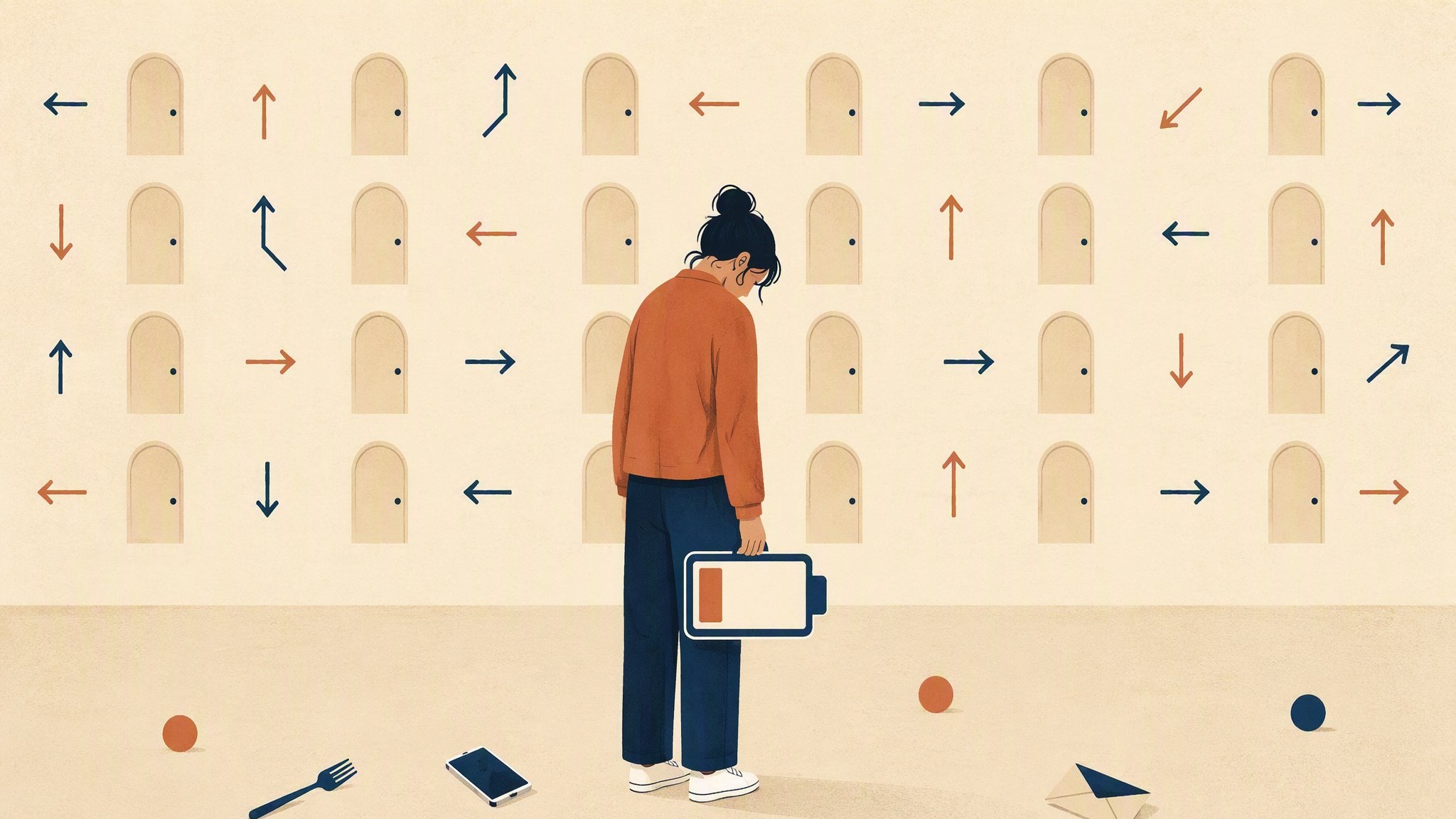
Decision Fatigue: Why Your Willpower Quits at 6 p.m. and How to Stop Needing It
You’re not weak in the evenings. You’re out of decisions. The fix isn’t more discipline — it’s fewer choices at the moments you’re least equipped to make them.
At 8:15 this morning you chose eggs over the pastry without a flicker of effort. At 8:15 tonight you ate half a bag of chips standing in front of the open pantry, ordered takeout you didn’t want that much, and skipped the workout you’d been genuinely looking forward to — all within about forty minutes. Same person. Same values. Wildly different behavior. If you’ve ever wondered what happened to your discipline between breakfast and dinner, the answer is mostly that nothing happened to it. You spent it. Every choice, suppression, and tiny act of self-control across the day draws on the same limited capacity, and by evening the account is running on fumes.
The Fuel Gauge Nobody Sees
What decision fatigue actually is
Decision fatigue is the deteriorating quality of choices after a long stretch of choosing. It’s not a metaphor. Judges, shoppers, doctors, and dieters have all been studied making worse or more avoidant decisions as the day wears on — not because they got dumber, but because deciding is metabolically and cognitively expensive, and the expense accumulates.
The critical thing to understand is what counts as a “decision.” It’s not just the big ones. It’s whether to answer that email now or later. Which task to start. What to make of a colleague’s odd tone. Whether the traffic merits leaving early. Whether to correct the kid or let it go. A normal adult day contains hundreds of these micro-choices, plus a steady background hum of suppressed impulses — don’t check the phone, don’t snap, don’t eat that, don’t say the thing. Every draw lands on the same account.
This is why willpower fails so predictably in the evening, and why it fails in such a specific direction. Depleted people don’t become random; they default. They take the path of least resistance, which in a modern home means the couch, the screen, the easy food, and the postponed intention. The American Psychological Association’s work on stress underlines how chronic load erodes self-regulation over time — decision fatigue is the daily, smaller-scale version of the same story.
The Two Failure Modes
Bad choices and no choices
Decision fatigue shows up in two costumes, and recognizing which one you’re wearing matters for the fix.
Failure mode one: impulsive choosing. The depleted brain stops doing cost-benefit math and grabs whatever is immediately rewarding. This is the chips, the impulse purchase, the “one more episode” that becomes four. It feels like a craving but it’s closer to a shrug — the part of you that would run the comparison between the chips and your goals has clocked out, so the loudest option wins by default.
Failure mode two: decision avoidance. The other depleted move is not choosing at all. Staring at two dinner options until it’s 9 p.m. and cereal happens by forfeit. Leaving the email unanswered not because it was hard but because it required a decision. Procrastination, especially the evening kind, is often just decision fatigue wearing a disguise. You’re not lazy; you’re out of the specific currency that choosing costs.
Most evenings alternate between the two — impulsive about food and screens, avoidant about anything that smells like effort. Neither is a character flaw. Both are symptoms of an empty tank, and an empty tank has engineering solutions.
The Myth of the Evening Second Wind
Why “I’ll do it tonight” keeps failing
Most self-improvement plans die at the same intersection: the plan assumes evening-you will have the same resources as morning-you, and evening-you never does. “I’ll meal-prep after work.” “I’ll start the budget tonight.” “I’ll work on the resume once the kids are down.” These plans are written by a well-resourced morning brain and handed to a depleted evening brain, like giving car keys to someone who hasn’t slept.
There’s a harder truth underneath: the evening is also when decisions cluster. What’s for dinner, whether to exercise, how to spend the two free hours, when to go to bed — the day saves up its most optional, most values-laden choices for exactly the hours when choosing capacity is lowest. It’s a scheduling accident that most people respond to with self-criticism instead of redesign.
So the reframe: stop asking “how do I get more willpower at night?” and start asking “why does anything at night still require willpower?” Every evening decision you can eliminate, automate, or relocate is a withdrawal you never have to make.
Move the Decisions, Don’t Make Them
The relocation strategy
The most powerful fix is temporal: make decisions when you’re rich, and spend the evening executing rather than choosing.
Decide tomorrow tonight — early. Not at 10 p.m., but right after work or during an afternoon lull: tomorrow’s top task, tomorrow’s lunch, tomorrow’s workout time. Two minutes of choosing while capacity remains beats an hour of depleted dithering.
Move the week’s big choices to Sunday. Meals, schedule, priorities. Not a rigid plan — a sketch. “What’s dinner on Tuesday?” is a trivial question on Sunday afternoon and a genuinely hard one on Tuesday at 6:40 p.m. Same question, wildly different cost.
Choose once, reuse forever. The capsule-wardrobe logic applies far beyond clothes. A standing breakfast. A default lunch. A fixed grocery template. Every recurring decision you convert into a standing decision pays you back daily, forever, in a currency you can’t otherwise buy.
Notice what this strategy doesn’t involve: trying harder. It’s purely architectural. You are rearranging the day so that the depleted version of you inherits as few open questions as possible.
Automate the Trivial
Defaults, subscriptions, and the tyranny of small choices
The second fix is elimination: an enormous share of daily decisions shouldn’t be decisions at all.
Go through a typical day and count the choices that produce almost no value either way. Which route to drive. Which mug. Whether to work out now or in twenty minutes. What to watch. Each one is tiny, and together they’re a tax on everything that matters. The goal is a life where the unimportant is on autopilot so the important gets your full budget.
Practical versions: standardize breakfast and lunch on weekdays (dinner stays free — variety where you actually enjoy it). Put recurring purchases on reorder. Set the same wake time seven days a week so bedtime stops being a nightly negotiation. Pre-commit your gym days as calendar events with the same status as meetings — a scheduled thing is no longer a decision, it’s just what happens at 5:30.
Habits are the deepest form of this automation. A behavior that runs on habit costs almost nothing, which is why building good ones is the highest-leverage energy investment there is. NIH’s News in Health on breaking bad habits explains the loop structure — cue, routine, reward — that lets behaviors run without drawing on willpower at all. You’re not born with these loops; you install them, one at a time, and each one is a permanent reduction in your daily decision bill.
Reduce the Load Itself
Sometimes the answer is fewer decisions, full stop
There’s a ceiling to clever scheduling. If your day is a genuine decision marathon — a job of constant judgment calls, plus a household of logistics, plus the ambient decisions of modern life — the honest fix is structural: fewer decisions need to exist.
This is where saying no becomes an energy strategy rather than a social one. Every commitment you decline is not just time saved; it’s all the future micro-decisions that commitment would have generated. A meeting declined eliminates thirty choices. A volunteer role not taken eliminates hundreds. People who seem to have endless discipline are often just people who have ruthlessly limited the surface area of their lives.
At home, the same logic applies to other people’s decisions that have migrated to you. If you are the household’s default decider — what’s for dinner, when’s the appointment, where does this go — you’re carrying a second job’s worth of invisible choosing. Distributing that load, with real ownership rather than delegation-with-supervision, is decision-fatigue prevention, not just fairness.
Refill the Tank (Partially, Anyway)
What actually restores capacity
You can’t fully refill mid-day, but you can slow the drain and add a little back. The restorers are unglamorous and real:
Food. Decision-making draws on glucose; making choices hungry is making choices with a handicap. The 4 p.m. slump is often lunch wearing off, and it’s a terrible time to decide anything important.
Actual breaks. Not phone breaks — those are just more micro-decisions in a smaller font. A walk, a window, ten quiet minutes. The test is simple: did your mind stop choosing for a while?
Sleep. This is the big one and it compounds. A short night means you start the next day with a smaller tank, which means more depletion by evening, which means the late-night revenge-scrolling that shortens the next night. The cycle is vicious and extremely common. Protecting sleep is the closest thing to a willpower supplement that exists.
Stress reduction. Background stress taxes self-regulation continuously — it’s a running app draining your battery even when you’re not looking at it. Whatever genuinely lowers your ambient stress level indirectly raises your evening decision quality.
Designing an Evening That Doesn’t Need Willpower
The endgame: a night that runs itself
The mature version of all this is an evening engineered so that good behavior is the path of least resistance, because that’s the only path depleted brains reliably take.
Walk through your ideal evening and ask, of each piece, “what would make this automatic?” The workout happens because the bag is packed by the door and the class is booked — deciding was done Sunday. Dinner is the meal you sketched three days ago, with ingredients already in the house, so the pantry stare has nothing to work with. The phone charges in the kitchen after 9, so the scroll requires getting up. The book is on the pillow. Bedtime has an alarm — not to wake you, but to tell you to start winding down, because “when should I go to bed?” is the last decision of the day and by then you’re in no shape to make it.
None of this is rigid or joyless. It’s the opposite: it protects the evening for the things you actually chose, by removing the hundred tiny choices that were crowding them out. Freedom isn’t the maximum number of decisions. It’s spending your limited decisions on things that matter to you.
The Social Tax: Decisions Other People Hand You
The invisible second shift of choosing
Some of your decision load isn’t yours at all. It’s imported. “What do you want to do about the party?” “Where should we eat?” “Should we get the blue one or the gray one?” Each of these arrives as a small social moment and lands as a withdrawal from your account. Multiply by coworkers, a partner, kids, and a group chat, and a meaningful share of your daily depletion came through the door in other people’s hands.
The defensive move isn’t refusing to engage — it’s changing the format. Open-ended questions are expensive; constrained ones are cheap. “Italian or Thai?” costs a fraction of “where should we eat?” “Here are two options, pick one” is a kindness you can offer people who’d otherwise hand you a blank page. When you’re the one being asked and you’re running low, a surprisingly honest answer works well: “I have no decision left in me — you pick, and I’ll be happy with it.” Most people hear this as generosity, which it is, in both directions.
At work, the same principle scales: meetings that exist to “discuss” rather than decide are decision factories. An agenda with a stated decision to be made, or a proposal circulated in advance, converts an hour of collective depletion into ten minutes of actual choosing.
Track It for Three Days
The audit that makes the problem visible
Decision fatigue is hard to fix in the abstract because it’s invisible in the moment — each individual choice feels free. A short audit makes the pattern undeniable. For three ordinary days, keep a rough tally: every time you choose something, suppress an impulse, or get handed a decision by someone else, make a mark. Don’t change anything yet. Just count.
Two things reliably emerge. First, the raw number is startling — usually well into the hundreds. Second, the distribution is lopsided: a small set of recurring decision categories (food, scheduling, other people’s questions, phone-related micro-choices) accounts for most of the total. That’s your target list, and it’s much shorter than “my whole life.”
Pick the top category and apply one fix from this article — automate it, relocate it, or delete it — for a week before touching the others. Stacking five redesigns at once is itself a decision binge, and it tends to collapse. One category at a time is slow in theory and fast in practice, because each fix stays fixed.
The Phone Is a Decision Machine
The one device worth singling out
It deserves its own section: the smartphone is the most efficient decision-fatigue generator ever built. Every notification is a forced choice — engage or dismiss, now or later, reply or leave it. Every open feed is a thousand micro-decisions per hour about what to look at, what to skip, whether to tap. An evening of “relaxing” with a phone is, neurologically speaking, an evening of unpaid choosing, which is why it leaves people more depleted than an evening of doing almost anything else, including nothing.
The countermeasures from earlier apply with extra force here. Notifications off by default, on by exception. Apps that exist to be scrolled get moved off the home screen or off the phone. And the single strongest move: a charging spot outside the bedroom and away from the couch, so that picking it up is a decision you have to notice making.
This article is educational and not medical or psychological advice. Sources referenced include the American Psychological Association and NIH News in Health. No affiliate links or sponsored content. External links verified live at publication, August 2026.