Overthinking: Why Your Brain Loops and How to Interrupt It
You’ve now had the same thought forty times and are no closer to anything. That’s not thinking. That’s rumination, and it has an off switch, once you know where to look.
The shower is where it happens. Or the drive, or the pillow. Your brain queues up the conversation from Tuesday, the one where you said the slightly wrong thing, and runs it again. Then again with better dialogue. Then it branches: what did they think, what should you have said, what does this mean about you, remember that similar thing in 2014. Twenty minutes vanish. You emerge from the shower no cleaner in any sense that matters, having generated zero decisions, zero plans, and one (1) fresh layer of dread.
Psychologists call this rumination, and distinguishing it from useful thinking is the entire first step, because your brain will swear the loop is problem-solving. It isn’t. It’s a treadmill wearing a treadmill’s clothes. This article covers why the loop runs, why it feels productive, and the specific interrupts that work, drawn from the same research base that treats the anxiety and depression rumination so often feeds.
Rumination vs. Reflection Know which one you’re doing
Reflection is thinking that moves: it examines a problem, produces an insight or a plan, and ends. Rumination is thinking that orbits: same content, same emotional tone, no output, repeat. The differences are testable in real time. Reflection asks “what can I do?” Rumination asks “why does this always happen to me?” Reflection ends with a next step, however small. Rumination ends with the starting question, ready for lap two. Reflection leaves you slightly tired but settled. Rumination leaves you activated and unresolved.
The clinical stakes are not trivial. Rumination is one of the best-studied transdiagnostic processes in mental health, meaning it shows up across conditions, and heavy habitual rumination predicts the onset and maintenance of both anxiety and depression in longitudinal research. It’s not a harmless quirk of the thoughtful; it’s more like a leaky pipe behind a wall, quiet, constant, and damaging in proportion to how long it runs. The NIMH’s mental-health self-care guidance emphasizes exactly the skills, noticing patterns, redirecting attention, that this article operationalizes.
Why the Brain Loops It’s trying to protect you, badly
Rumination isn’t a malfunction; it’s a protection system misfiring. Your threat-detection circuitry treats unresolved social and practical problems the way it treats physical danger: keep them active, keep scanning, don’t drop the thread. An unanswered slight, an unfinished project, an ambiguous “we need to talk”, each one stays flagged as open, and the flag keeps surfacing the content for review. The loop feels like problem-solving because it’s made of the same machinery, analysis, prediction, replay, just running in a closed circuit with no exit condition.
There’s also a sneakier reinforcer: rumination gives the illusion of control. Worrying about the presentation feels like doing something about the presentation. It lets you avoid the scarier action (actually preparing, or actually having the conversation) while earning the sensation of diligence. And it sometimes works just often enough, the feared thing doesn’t happen, the problem ages away, to teach the wrong lesson: the loop takes credit for outcomes it had nothing to do with. That’s how the habit self-justifies for years.
The First Interrupt: Externalize Why paper beats processing
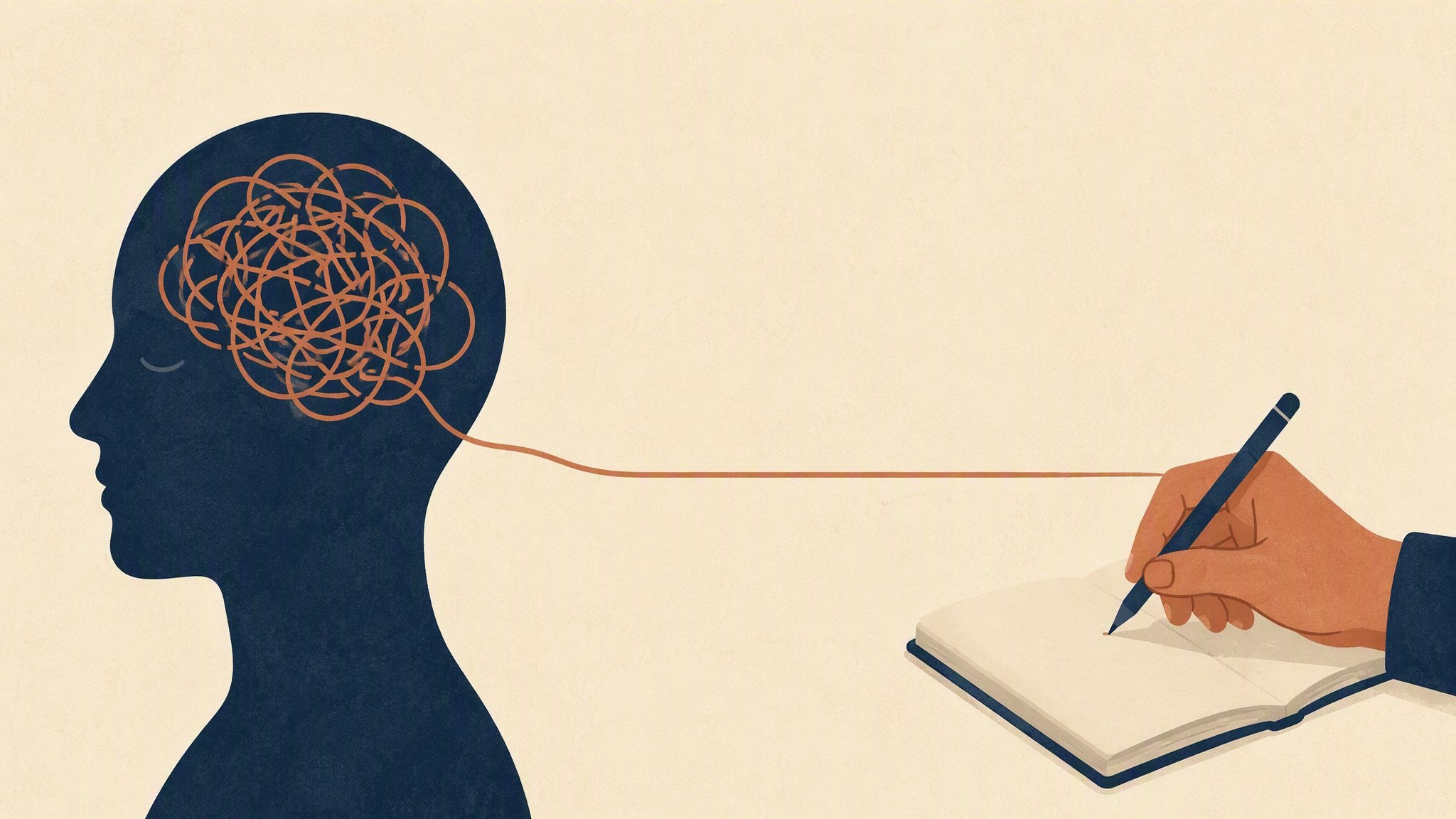
The single most reliable circuit-breaker is also the cheapest: get the loop out of your head and onto paper. Not prose, not journaling-as-literature, just the raw content, what’s looping, in plain sentences, plus two questions at the end: is there an action here, and if yes, what’s the smallest version of it? The mechanism isn’t mystical. Working memory holds only a few chunks; loops persist partly because the brain keeps re-staging the content to avoid losing it. Writing it down stores it externally, and the re-staging need drops. Studies of expressive writing and of to-do offloading both show reduced intrusive rethinking, the brain stops rehearsing what it’s allowed to forget.
The two-question suffix is what separates this from a worry diary. If an action exists, it goes on a list, and the loop converts to a task. If no action exists, and most loops have none, you’ve demonstrated on paper that this is weather, not work: nothing to solve, only something to let pass. Either way, the loop’s fuel, the unresolved “open” flag, gets addressed directly.
Worry Time: The Scheduled Exception Containment instead of suppression
Suppressing thoughts backfires, that’s the famous white-bear finding: ordered not to think of a white bear, people think of nothing else. So don’t suppress; contain. The technique, straight from CBT’s toolbox: designate a daily fifteen-to-twenty-minute “worry appointment,” same time, with a notebook. When loops fire outside the appointment, jot the topic in one line and defer it: “Noted. Four-thirty.” Then actually hold the appointment and worry deliberately, on paper, until the timer ends.
It sounds too cute to work, and the evidence says otherwise: scheduled worry reduces overall rumination time in trials, because most deferred worries, when the appointment arrives, no longer feel urgent. The ones that do get fifteen honest minutes and the action test. What you’re really training is the discovery that a loop can be postponed, and anything postponable is interruptible. The loop’s whole power was the illusion that it had to be now.
Distraction Done Right
The difference between a break and a bunker
Suppression doesn’t work. There’s a famous psychology finding — often called the white bear effect — showing that trying not to think about something makes you think about it more. Telling yourself “stop thinking about the email” is a direct order to your brain to keep checking whether you’re thinking about the email.
Distraction is different. You’re not forbidding the thought; you’re giving attention somewhere better to be. The distinction matters because one fails reliably and the other works fairly well, at least as a short-term interrupt.
What makes a good distractor for rumination? Three properties. It should be absorbing — passive scrolling doesn’t count, because it leaves most of your mind free to loop in the background. It should be finite — something with an end, so it doesn’t become avoidance. And it should be incompatible with looping — a conversation, a puzzle, a recipe you have to follow, a game that keeps score.
Notice what those have in common: they occupy the same mental workspace rumination wants. You can’t hold a real conversation and rehearse an imaginary one at the same time. That’s the whole mechanism. You’re not fighting the loop; you’re evicting it.
One caution. If distraction is your only tool, it curdles into avoidance, and the unfinished problem waits for you in the shower tomorrow. Distraction buys quiet. Use the quiet to do one of the other things on this list.
Get Physical: The Interrupt That Doesn’t Argue
When the head won’t stop, move the body
Rumination is a head activity, and it survives on stillness. Lying on the couch, lying in bed, sitting in the car — these are loop habitats. Movement breaks the spell for a boring physiological reason: exercise demands enough sensory and motor attention that the loop loses its grip, and it burns off some of the physical arousal that keeps the loop feeling urgent.
You don’t need a workout. You need a state change. Ten minutes of walking, ideally outside, does more to interrupt a spiral than an hour of trying to think your way out of it — which makes sense, because thinking your way out is just more of the activity you’re trying to stop.
Slow breathing deserves its own mention because it works through the body in the other direction. A loop is usually paired with shallow, fast breathing and a slightly braced body. Deliberately lengthening the exhale — in for a count of four, out for a count of six, for a couple of minutes — sends a physiological “not an emergency” signal up to the brain. It’s not positive thinking. It’s a hardware reset. The American Psychological Association’s stress resources cover the stress-body connection in detail if you want the longer version.
The point of all of these is speed. When you catch a loop early, a two-minute interrupt works. When you catch it at minute forty, you’re negotiating with a much stronger current.
Zoom Out: Distance Tools
Self-talk, time travel, and the friend test
Rumination feels true partly because it’s in first person, present tense, and very close. Distance tools loosen that grip by changing the camera angle.
Third-person self-talk. It sounds silly and there’s real research behind it: referring to yourself by name, or as “you,” when working through a problem reduces the emotional heat compared with first-person “I.” “Why is Sam so rattled about this?” engages a slightly more observer-like mode than “why am I so rattled.” You’re giving yourself the tone you’d use with someone you like.
The time zoom. Ask: will this matter in ten days? Ten months? Most loop material fails the ten-day test, which doesn’t solve the problem but correctly re-sizes it. The ones that pass the ten-month test deserve actual planning time, not 2 a.m. looping time.
The friend test. If a friend described this exact situation, what would you tell them? People are consistently wiser and kinder about other people’s problems than their own. The friend test imports that wisdom back into your own case. It’s cheap and it works embarrassingly often.
None of these tools pretend the problem is fake. They correct the distortion where the problem fills your entire field of view, which is the state in which nothing gets solved anyway.
Tolerating “I Don’t Know Yet”
The uncertainty muscle
Underneath most chronic overthinking sits an intolerance of uncertainty. The loop promises that if you think long enough, you’ll arrive at certainty — the email can’t hurt you, the decision can’t be wrong, the future can’t surprise you. That certainty is never coming, so the thinking never ends.
The fix isn’t finding certainty. It’s getting better at operating without it. That sounds grim but it’s actually relaxing: if certainty was never on the table, you can stop performing the ritual that was supposed to produce it.
A practical version looks like this. When you notice the loop demanding a guarantee, answer it honestly: “I don’t know how this goes. I’ll handle it when it happens, like I handled the last hundred things.” Then do the next concrete action the situation actually allows, or no action at all if none is available. Most people are surprised by how competent they’ve been at handling the things that actually happened, compared with the catastrophes that didn’t.
This is a skill, and it builds with reps, not insight. Every time you leave an “I don’t know” sitting there without feeding it another hour of analysis, the muscle gets a little stronger.
When Loops Are More Than a Habit
Knowing when to escalate
Everything above assumes garden-variety overthinking — annoying, time-consuming, but fundamentally a habit. Sometimes looping is a symptom of something that deserves professional attention, and it’s worth knowing the markers.
Consider talking to a professional if the rumination is constant rather than situational, if it’s paired with persistent low mood or loss of interest in things you used to enjoy, if it comes with compulsions — rituals you have to perform to feel safe — or if the content turns toward hopelessness or self-harm. Generalized anxiety, depression, and obsessive-compulsive patterns all feature looping prominently, and all of them respond well to treatment. Self-help techniques are fine as a complement, but they’re not the whole answer when the loop is clinical.
A good rule of thumb: if you’ve genuinely applied tools like these for a month and the loops are just as loud, that’s useful information. It means the loop is doing a bigger job than a bad habit does, and a professional can help you figure out what job that is.
A Working Anti-Loop Kit
Putting it together in real life
Here’s the whole thing assembled into a sequence you can actually run when you catch yourself mid-spiral:
Step one: name it. “I’m looping.” Naming the process shifts you from inside it to observing it, and that small shift is the doorway to everything else.
Step two: externalize. Two minutes of pen-and-paper dumping. What’s the actual issue? Is there an action available? If yes, write it down as a task. If no, write “no action available — scheduled or none.”
Step three: interrupt the body. Stand up. Walk, breathe with a long exhale, do something with your hands. Two to ten minutes. You’re not solving anything here; you’re changing states.
Step four: redirect on purpose. Choose something absorbing and finite — not your phone’s infinite scroll, which is rumination with a screen.
Step five: schedule the worry if it insists. If the loop returns, it gets an appointment. Most don’t show up.
Run this enough times and something shifts: you catch loops earlier. The shower argument gets interrupted at minute one instead of minute twenty. That early catch is the real skill — the tools are just what you do after it.
Why Nighttime Makes Loops Louder
The 2 a.m. amplification problem
Loops have a prime time, and it’s the middle of the night. This isn’t weakness or bad character — it’s context. At 2 a.m. there is no input competing for your attention: no tasks, no people, no daylight. The loop gets the whole stage. On top of that, a tired, half-awake brain is measurably worse at the regulation job. The part of you that would normally say “this again? we’re done here” is asleep even when you aren’t.
So judge nothing at night. That’s the rule. Nothing true about your life, your relationships, or your career gets decided at 2 a.m., because the instrument doing the evaluating is compromised. If a night loop arrives with an urgent insight, write down three words about it and look at them at lunch. Almost every time, the lunch version of you reads the note and wonders what the emergency was.
If night loops are a regular pattern, the fix is upstream: a firmer wind-down, the paper dump before bed instead of in bed, and a stricter cut-off for problem-solving after a set hour. The brain learns schedule. If it learns that 11 p.m. is when the analysis channel opens, it will keep booking that slot.
This article is educational and is not a substitute for professional mental-health care, diagnosis, or treatment. Sources referenced for further reading include the National Institute of Mental Health and the American Psychological Association. No affiliate links or sponsored content. External links verified live at publication, August 2026.