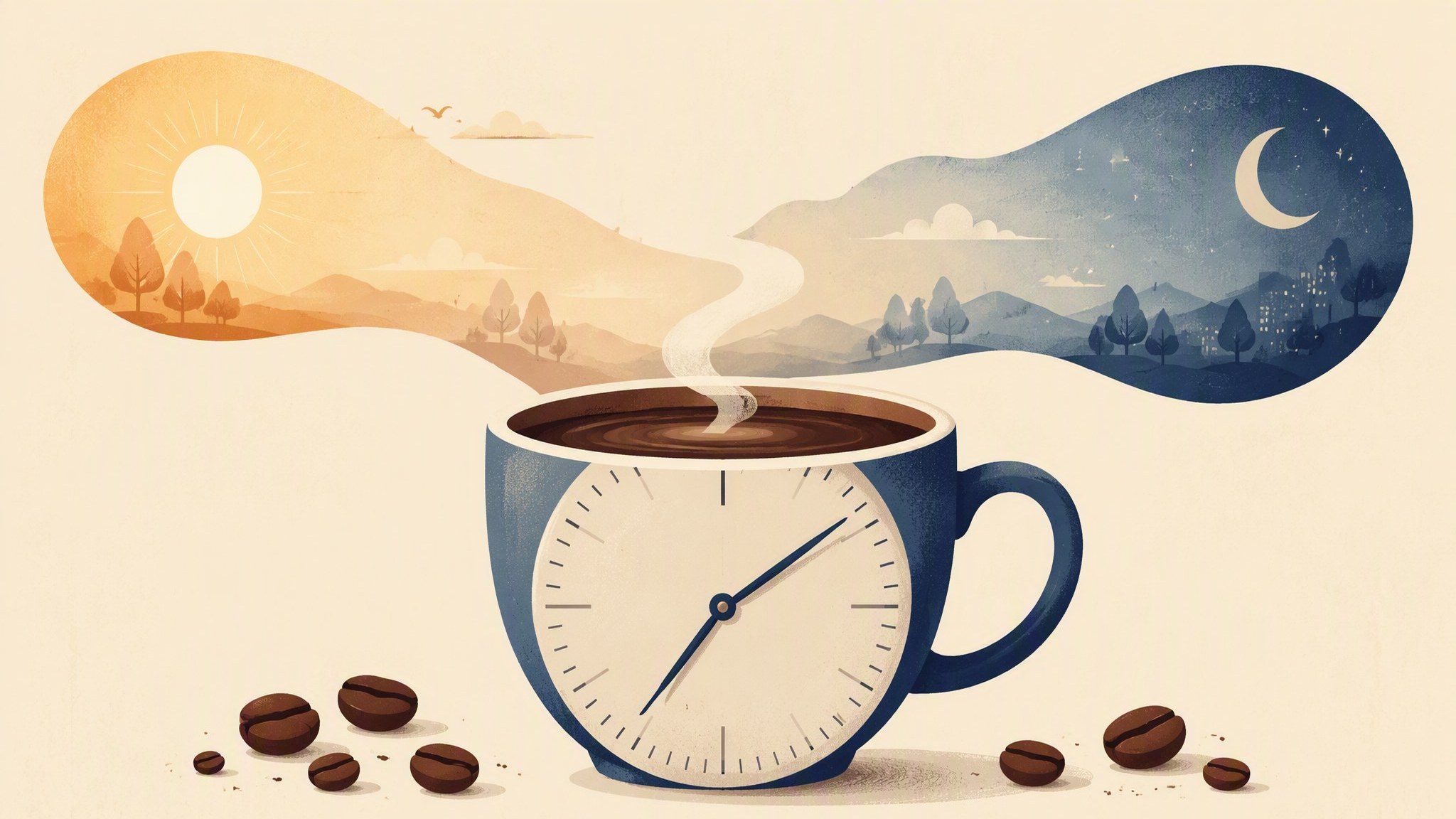
Caffeine Has a Half-Life: The Timing Math That Protects Your Nights
“Coffee doesn’t affect me, I can drink it after dinner and sleep fine.” That sentence is doing a lot of work, and most of it is wrong. Here’s the arithmetic your evening cup is hiding.
Everyone knows a person, or is the person, who drinks an espresso after dinner and swears it doesn’t touch their sleep. They’re telling the truth about falling asleep, mostly. What they can’t see, because nobody can feel it directly, is what’s happening to the sleep itself: shallower architecture, less deep sleep, more micro-awakenings, a night that looks like eight hours and restores like six. Caffeine doesn’t usually stop you from sleeping. It taxes the sleep you get, quietly, and the bill arrives as the daytime tiredness you then fix with more caffeine. It’s an elegant loop, and half the adult population is living in it.
The good news is that caffeine is the most predictable drug you’ll ever take. It follows simple, knowable math, and once you see the math, the timing rules write themselves. This article is the math, the individual variations that bend it, the hidden sources that break it, and a two-week reset if you want to find out what your natural energy actually feels like.
What Caffeine Actually Does A loan, not a gift
Caffeine doesn’t create energy. It blocks the signal that tells you energy is spent. As your brain works through the day, a chemical called adenosine accumulates and plugs into receptors, and that plugging-in is the sensation of mounting drowsiness. Caffeine’s trick is structural: it’s shaped enough like adenosine to fit the receptors, but it doesn’t activate them. It just occupies the seat. The adenosine keeps building up in the background, uncounted. You haven’t removed the tiredness; you’ve muted the notification.
Two consequences follow. First, when the caffeine finally clears, the accumulated adenosine is still there, which is why the late-afternoon crash can feel like a wave rather than a slope. Second, caffeine consumed late in the day is still occupying receptors when you’re trying to sleep, and sleep under partial blockade is lighter and less restorative, even when you don’t consciously wake. Studies using lab sleep measurement have found that caffeine six hours before bed measurably reduces total sleep time and deep sleep, even in people who report sleeping “fine.” Feeling fine and sleeping well, it turns out, are different measurements.
The Half-Life Math The number that changes your afternoon
Caffeine’s half-life, the time for your body to clear half of it, averages around five to six hours in healthy adults, with a wide honest range of roughly two to ten depending on the person. Run the arithmetic on a normal day. A large coffee at 8 a.m. (call it 200 milligrams) leaves about 100 mg active at 1 or 2 p.m. Add another coffee at 4 p.m. and by midnight you’re still carrying something like 50 to 100 mg, the caffeine equivalent of a small coffee or a strong tea, circulating while you try to descend into deep sleep. The 4 p.m. cup is, pharmacologically speaking, also a midnight cup.
This is where the standard cutoff advice comes from: last caffeine roughly eight to ten hours before your target bedtime, which for an 11 p.m. sleeper means early afternoon. It sounds austere until you run your own numbers and realize your “afternoon pick-me-up” has been attending your nights uninvited for years. The NHLBI’s sleep guidance lists late caffeine among the classic sleep disruptors; the half-life is the reason it’s on the list.
Your Mileage Varies, Measurably Genetics and the fast metabolizers
The two-to-ten-hour range is mostly genetics: a liver enzyme handles caffeine, and variants in the gene for it split people into fast and slow metabolizers. Fast metabolizers clear a coffee in a few hours and can genuinely flirt with afternoon cups; slow metabolizers carry caffeine far longer and pay for a 2 p.m. coffee at midnight. You can’t feel which group you’re in, the after-dinner espresso people are often just slow metabolizers who’ve never run the experiment, but you can test it: two caffeine-free weeks, then a controlled reintroduction, watching sleep quality rather than sleep onset.
Other factors move the number too. Pregnancy roughly doubles the half-life by the third trimester. Some medications and hormonal contraceptives slow clearance. Smokers clear caffeine faster. Age slows it. And regular use builds tolerance, your brain responds to chronic blockade by growing more adenosine receptors, which is why daily drinkers need their coffee to feel normal rather than superhuman, and why the morning cup of a habitual drinker is largely withdrawal relief. The first coffee doesn’t lift you above baseline; it returns you to it. That reframing alone changes how people think about the afternoon cup.
The Hidden Sources Where the audit gets surprising
People count coffee and forget the rest of the inventory. Black and green tea carry meaningful doses, especially strong brews and matcha, which delivers a coffee-adjacent hit in a wellness costume. Dark chocolate and cocoa are real sources, small but not nothing in the evening. Cola and the energy drinks are obvious, but the “pre-workout” powders and fat-burner supplements are caffeine bombs that people take at 6 p.m. before the gym and then puzzle over their destroyed nights. Decaf isn’t zero, typically a few milligrams per cup, trivial alone but not if you drink four. Some headache and cold medications contain caffeine explicitly, because it boosts painkiller absorption. And the coffee-shop large is nobody’s friend: sizes and strengths vary so wildly that two “coffees” can differ by a factor of three.
The audit, then: list everything, everything, for one week, with rough milligrams. Most people find their total is double their guess, and their last dose is hours later than they’d have said. You can’t time what you haven’t counted.
Using It Well Caffeine as a tool instead of a drip
None of this is an argument for quitting. Caffeine is a genuinely useful, well-studied compound: it reliably improves alertness, reaction time, endurance performance, and, in habitual moderate amounts, is associated in research with a number of favorable health outcomes. The goal isn’t abstinence; it’s deployment. Strategic caffeine looks like: a consolidated morning window (one or two doses, done by early afternoon), saved-up doses before the things that matter (a long drive, a hard workout, a big presentation), and deliberate days off or low days to keep tolerance from flatlining the effect. Used this way, caffeine is a scalpel. Used as an all-day IV against chronic sleep loss, it’s a treadmill you’re also paying for.
Two tactical notes. The “coffee nap,” caffeine then an immediate twenty-minute nap, works because the nap clears some adenosine while the caffeine absorbs, and you wake as both effects land; it’s the most effective legal alertness trick for a hard afternoon or a long drive. And the delayed-first-cup idea, waiting sixty to ninety minutes after waking, has a plausible mechanism (letting your natural morning cortisol peak do its job first) and devoted fans, though the evidence is thinner than the confidence of its influencers. Try it if mornings feel flat; skip the dogma if it doesn’t.
The Afternoon Slump Isn’t Fixed by Caffeine Usually
The 3 p.m. coffee is usually aimed at the wrong target. The afternoon dip is substantially circadian, a scheduled trough in alertness your clock produces daily, plus, often, a heavy lunch and a night of taxed sleep. Caffeine pasted over it borrows against tonight to fund this afternoon, and the loop tightens: worse night, bigger dip, later coffee. Breaking the loop means treating the dip directly: a ten-to-twenty-minute walk (light plus movement, the free version), a twenty-minute nap if your situation allows, a lighter lunch, and, the long game, better nights. Once the nights improve, most people discover the afternoon coffee wasn’t load-bearing at all. It was scaffolding on a building that just needed its foundation back.
The Two-Week Reset If you want to know your baseline
If you’re curious what you actually feel like without the drip, the experiment is simple and temporarily unpleasant. Week one: consolidate to a single morning dose and cut it by a third every two days, tapering beats quitting, because abrupt cessation reliably produces a headache-and-fog withdrawal that peaks around day two and fades within about a week. Week two: zero caffeine, or a ceremonial green tea if that feels more human. Keep everything else constant so you’re actually testing caffeine.
Then observe honestly: sleep depth, morning energy, the shape of the afternoon, anxiety levels (caffeine amplifies jitteriness in the anxiety-prone, and some people discover a chunk of their “anxiety” was espresso). Most people who complete it report the same arc: a rough first week, then a surprising flatness of energy, fewer peaks, but no crashes, and mornings that arrive without the urgent need. Many then reintroduce caffeine deliberately, as a morning tool with an afternoon curfew, which is where most of the benefit and almost none of the cost lives. The CDC’s sleep basics include the stimulant-timing point in its standard advice; now you know the arithmetic underneath it.
When to Take It Seriously The edge cases
A few situations call for more than a timing tweak. Palpitations, chest flutters, or panic-like episodes after caffeine deserve a doctor’s input, not a smaller latte. Pregnancy has its own recommended limits (widely set around 200 mg daily), which is a conversation for your clinician. If you can’t cut back despite wanting to and clear costs, that’s a real dependence pattern, manageable, but worth treating as such rather than as a joke about being a coffee person. And if you’re using escalating caffeine to survive escalating exhaustion, step back and ask what the caffeine is compensating for, because the answer is usually sleep debt, sleep apnea, or a schedule problem, and those have real fixes. Caffeine is the world’s most successful drug for a reason. Just make sure you’re the one holding the prescription.
The Rough Milligram Map Know your doses
Caffeine labeling is a mess, so a working mental table helps. Values are typical ranges, because a “coffee” can mean almost anything.
| Source | Typical caffeine | What’s left at midnight if taken at 4 p.m.* |
|---|---|---|
| Home-brewed coffee (mug) | 80–120 mg | 40–60 mg |
| Coffee-shop large / “grande” | 200–330 mg | 100–165 mg |
| Espresso (single) | 60–80 mg | 30–40 mg |
| Black tea (strong brew) | 40–70 mg | 20–35 mg |
| Green tea / matcha | 25–70 mg (matcha higher) | 12–35 mg |
| Cola (can) | 30–45 mg | 15–22 mg |
| Energy drink (can) | 80–200+ mg | 40–100+ mg |
| Pre-workout scoop | 150–300+ mg | 75–150+ mg |
| Dark chocolate (50 g bar) | 20–40 mg | 10–20 mg |
| Decaf coffee | 2–7 mg | trace |
*Assuming an average five-to-six-hour half-life; slow metabolizers can double what’s left. The right-hand column is the one that changes behavior. Nobody thinks of a grande at 4 p.m. as a bedtime beverage, but the table disagrees.
The Tolerance Trap Why the magic fades
Notice what happens to any daily caffeine habit over months: the first-ever coffee was a rocket, the fiftieth was pleasant, the five-hundredth is just… Tuesday. That’s receptor upregulation in action, your brain grew more adenosine receptors to hear the signal through the blockade, so now you need caffeine to reach what used to be your unmedicated normal. The practical consequence is uncomfortable: the daily drip’s benefits are largely illusory, you’re paying for baseline. The studies showing cognitive benefits of caffeine mostly show them in non-habitual users or in habitual users after abstinence. In other words, caffeine works best on people who aren’t marinated in it. The strategic user, morning-only, some low days, keeps the magic. The all-day dripper is paying rent on a placebo with side effects.
A Word About Teenagers The energy-drink generation
If there are teenagers in your house, this section matters more than the rest of the article. Adolescent brains are more sensitive to caffeine, teens need more sleep than adults (eight to ten hours is the standard guidance), and the energy-drink market has spent two decades teaching them to borrow against it. The pattern, giant sweetened caffeine at 4 p.m., fragmented sleep, exhaustion, more caffeine, is the adult loop installed at sixteen, during the years when sleep is doing irreplaceable brain development and school scheduling already works against them. Pediatric and cardiology bodies have been blunt: energy drinks have no place in kids’ diets, full stop. The household fix isn’t a lecture (it will lose to the marketing); it’s the audit table above, run together, and a home where the adults model the cutoff. Kids learn the caffeine rules from your hands, not your speech.
Keep the Ritual, Move the Drug The part quitting advice always misses
One reason caffeine advice fails so reliably is that it treats coffee as chemistry when it’s mostly culture. The morning cup is a ritual, warmth, smell, the ten quiet minutes before the day; the afternoon coffee is often really a walk, a break, a conversation with a colleague; the espresso after dinner is punctuation at the end of a good meal. Advice that says “cut the afternoon coffee” hears itself as pharmacology and is heard by the drinker as “cancel the break, decline the walk, skip the ritual.” No wonder it doesn’t stick. The durable fix is substitution, not amputation: keep the walk and the colleague, change what the cup holds (decaf after the cutoff is genuinely fine at two to seven milligrams, herbal tea works, even the same mug matters more than its contents). The ritual is worth keeping; it’s the molecule that needs a curfew. Separate those two things in your mind and the whole recalibration stops feeling like loss and starts feeling like what it is: same life, better nights.
This article is general education, not medical advice; pregnancy, heart symptoms, and anxiety disorders all change the caffeine conversation, so involve a clinician. Sources linked above include the NHLBI and the CDC. This article contains no affiliate links and no product recommendations. All outbound links checked live in August 2026.