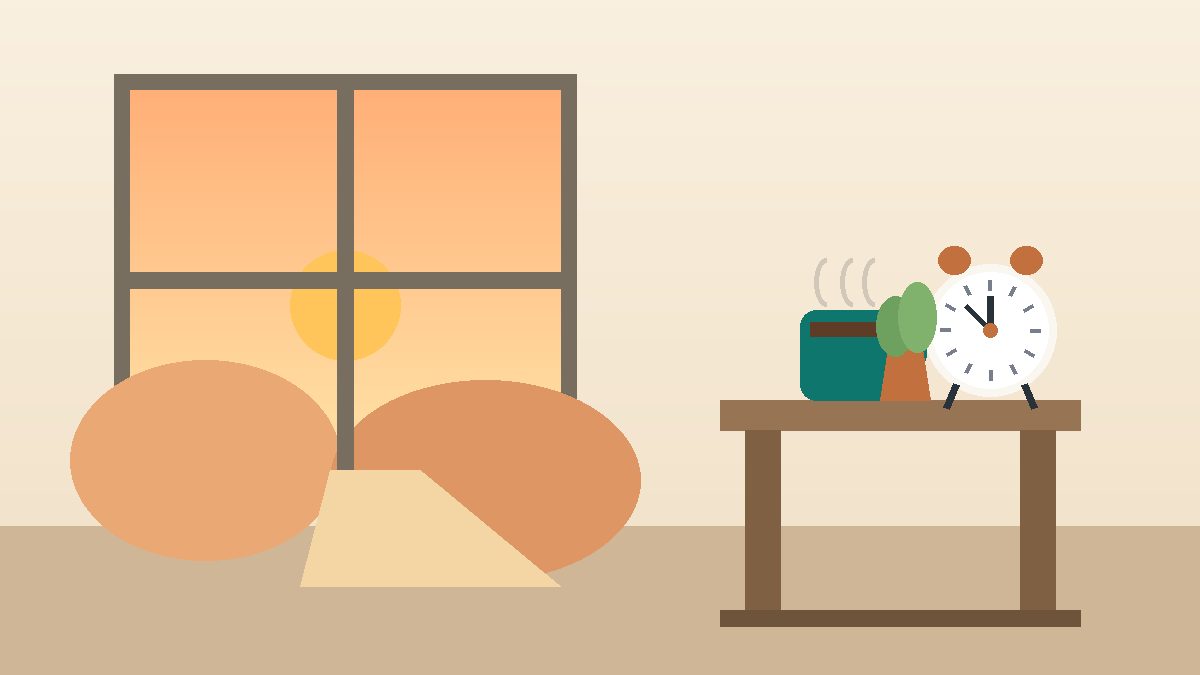
A Morning Routine That Survives Real Life
Not the 5 a.m. ice-bath influencer version. A flexible, fifteen-minute structure that works on the bad mornings too — especially the bad mornings.
The morning routine industrial complex has a specific fantasy to sell you: 5 a.m. alarm, cold plunge, journaling, meditation, gratitude, a green something, ninety minutes of self-optimization before the world wakes. You’ve seen the videos. You may have tried the routine, once, for four days. Meanwhile, your actual mornings look like this: alarm, snooze, alarm, phone-in-face, a chaotic search for keys, coffee inhaled like medicine, and arrival at the day’s first obligation already feeling behind. The gap between the fantasy and the Tuesday isn’t a discipline gap — it’s a design gap. The influencer routine fails because it’s long, rigid, and optimized for content rather than for a person with a job, a household, and occasionally a toddler with opinions at 6 a.m. A routine that actually survives real life is short, anchored, flexible by design, and mostly built the night before. Here’s how to build one that still stands on your worst morning — because that’s the only kind worth having.
What Mornings Are Actually For
Redefining success downward, usefully
Strip away the optimization theater and a morning routine has exactly three jobs. First, orientation: a waking brain is a foggy brain, and it benefits from a predictable sequence that boots up the day without decisions. Second, physiology: a few inputs in the first hour — light, water, movement, food in some form — genuinely shift alertness and mood, with light being the heavy hitter (your circadian system sets its daily clock largely from morning light, which is why the Sleep Foundation’s circadian resources keep putting “get morning light” at the top of every list). Third, direction: thirty seconds of intention about what today is for, so the day doesn’t default to whatever screams first.
Notice what’s absent: self-improvement projects. The fantasy routine fails partly because it stuffs the morning with goals — fitness, mindfulness, learning — each of which deserves its own time slot and all of which collapse the morning into a schedule fragile enough to die on first contact with a bad night. The routine that survives treats mornings as a launchpad, not a battlefield: fifteen to thirty minutes, a fixed skeleton, and nothing in it that requires you to be your best self at your worst hour.
A useful reframe from habit research: the routine’s value isn’t any single element — it’s automaticity. A sequence repeated daily becomes one unit of effort instead of ten decisions, and that conserved decision-energy is available for the actual day. The NIH’s habit-change guidance puts it plainly: behaviors stick when they’re small, cued, and repeated — not when they’re ambitious. Build small, cue it well, repeat.
The Minimum Viable Morning
The fifteen-minute skeleton
Here’s the skeleton that survives everything, in order, with the reasoning exposed:
1. Same wake time (zero minutes). The anchor. A consistent wake time does more for how mornings feel than any element you add after it, because your body’s chemistry starts preparing for wake-up before the alarm — but only if it can predict the alarm. Sleeping in feels like a gift and functions like a small weekly time-zone change.
2. Light, immediately (two minutes). Open the curtains wide, step onto the balcony, or take the coffee outside. Outdoor light, even overcast, outperforms indoor light by an order of magnitude for clock-setting purposes. This is the single highest-leverage two minutes in the whole routine.
3. Water and movement (three minutes). A glass of water — you’ve gone eight hours without any — and anything that moves the body: ten slow squats, a stretch sequence, walking the dog. Not a workout; a signal to the system that the day has begun.
4. Food in some form (five minutes, overlapping). Whatever your household’s breakfast reality is — prepared the night before where possible. The morning is no place for culinary decisions.
5. The thirty-second direction (thirty seconds). One sentence, said aloud or written on a sticky note: “Today’s one thing is ___.” Not a to-do list — a flag planted. On chaotic days the flag is the only part of the plan that survives, and it turns out to be enough to change the day’s texture measurably.
Total: fifteen minutes, most of which you’d spend anyway, now sequenced and automatic — the difference between a morning and a sequence of morning-shaped decisions you no longer have to make. That’s the entire required routine. Everything else is optional decoration, and the decoration is where routines go to die.
The Night-Before Protocol
Where great mornings are actually manufactured
Ask people with calm mornings their secret and the honest ones confess: the morning is a performance of decisions made the night before. The night-before protocol is five minutes of closing procedures: tomorrow’s clothes decided and staged, the bag packed by the door with keys inside it (the key search is a decision-tree fire you never need to have again), breakfast staged or chosen, the kitchen reset enough that making coffee isn’t an act of archaeology, and tomorrow’s “one thing” already known.
The psychology here is decision removal, but the deeper benefit is identity: the night-before version of you is calm, rested(ish), and has good judgment. The morning version is a foggy gremlin. Every task moved from gremlin-hours to evening-hours is a transfer of responsibility to the more competent employee. People who run the protocol describe the morning change as eerie: the same house, the same schedule, but the morning feels like walking a path that someone thoughtfully cleared overnight — because someone did, and it was you, being a good colleague to yourself.
The protocol also catches the domino that knocks whole mornings over: the phone. If the phone is the alarm, the phone is the first thing in your hand, and the phone’s first offering is the world’s emergencies and other people’s priorities. The fix is blunt and effective: a cheap alarm clock, and the phone charging in another room overnight. The morning reclaimed from the scroll is usually twenty minutes and one entire mood.
Designing for the Bad Morning
The resilience test
Every routine works on the good morning. The design question is what happens on the bad one — the 4 a.m. kid wakeup, the insomnia night, the illness, the late return from a trip. Fragile routines respond to disruption by collapsing entirely, which is why most people’s routines have a lifespan measured in weeks. The resilient version has three properties:
A floor, not just a ceiling. Define the minimum viable version — maybe it’s “light + water + one sentence,” three minutes total — and declare in advance that the floor version counts fully. Habits die from the all-or-nothing interpretation: miss the full routine, feel the failure, abandon the project. The floor version converts disruption from failure into a planned variant.
No debt accounting. The routine resets daily, with zero carryover. Yesterday’s collapse doesn’t owe today’s routine anything. The APA’s stress research consistently links self-critical rumination to worse outcomes than the original disruption — the bad morning’s real cost is rarely the missed stretch; it’s the narrative about what the missed stretch means.
Disruption protocols. For the recurring chaos sources, pre-decide the variant: the travel version (light + water + five squats in the hotel room), the sick version (water + direction, from bed), the toddler version (the whole routine, but the toddler is a participant rather than an obstacle — kids, it turns out, love “doing mornings” and their chaos mostly objects to exclusion). Chaos that’s been rehearsed isn’t chaos; it’s a known track.
The Optional Shelf
Where the extras belong
Once the skeleton runs automatically — give it a month — the extras can attach safely, in order of evidence-per-minute. A longer walk outside (combining light, movement, and the thinking time that disappears from most days) is the highest-yield upgrade. A few minutes of quiet — meditation, prayer, staring at the garden — pays down the day’s stress before it accrues. Writing, whether journaling or planning, externalizes the mental clutter that otherwise rides along all day. Learning inputs (the podcast, the language app, ten pages of a book) work well if attached to an existing element — the walk, the coffee — rather than floating free.
The rule for the shelf: one addition at a time, a month apart, and each earns its place by surviving the bad mornings, not the good ones. The moment the routine stops surviving Tuesdays, the last addition gets demoted back to optional. This discipline sounds fussy; it’s actually the difference between a routine that compounds for years and one that becomes another monument to January.
The First Two Weeks
An installation plan
| Phase | What you do |
|---|---|
| Days 1-3 | Same wake time + light + water. Nothing else. Buy the alarm clock. |
| Days 4-7 | Add the three-minute movement and the night-before staging (clothes, keys, bag) |
| Week 2 | Add the thirty-second direction; define your floor version and write it down |
| Ongoing | Phone charges outside the bedroom; bad mornings run the floor version with zero debt |
| Month 2+ | Optional shelf additions, one at a time, bad-morning tested |
Two weeks in, the routine stops feeling like a routine — it’s just how mornings go, which is precisely the destination. The goal was never optimization. It was the quiet luxury of a morning that doesn’t start the day with a loss.
For the Night Owls Reading This in Despair
The routine doesn’t care when it happens
If your biology runs late — and for a sizable share of people it genuinely does — every word of this article still applies, with the timestamps shifted. The skeleton isn’t “wake at 5 a.m.”; it’s “the first hour after waking, whenever that is.” A night owl’s 8:30 wake-up gets the same light, the same water, the same thirty-second direction, with the same payoff. The only non-negotiable is consistency, because the clock-setting chemistry cares about predictability, not earliness. Where owls need extra honesty is the collision point: if work forces a 7 a.m. start onto a body that wants 9, the priority isn’t a longer morning routine — it’s protecting bedtime, because the owl running a morning-routine project on five hours of sleep is polishing the hood ornament of a car with no engine. Sleep first, routine second, heroics never.
The Household Morning
When your routine has dependents
Solo routine advice dissolves on contact with a shared household, so the family version deserves its own paragraph of realism. The design principles survive: same skeleton, same night-before protocol (kids’ clothes and bags staged is worth more than any single adult optimization), same floor version for bad days. What changes is the choreography: the routine gets staggered, with one adult up fifteen minutes earlier to boot the system (coffee made, lunches begun) before the kids’ phase starts — and yes, that role rotates, or the early-shift adult is quietly building resentment with the toast. Kids get their own visible sequence, because children run on the same automaticity adults do, and a five-year-old with a picture-chart routine (dress, teeth, breakfast, shoes) requires a fraction of the nagging of a five-year-old navigating an unplanned morning. The family morning that works isn’t serene — it’s sequenced, which is a much more achievable and, it turns out, more peaceful target.
What Six Months of This Buys
The compound interest of calm starts
The payoff of a survivable morning routine isn’t visible in any single day — it’s the accumulated subtraction of a thousand small deficits. Six months of consistent wake times and morning light is a measurably more stable energy curve across the day. Six months of the thirty-second direction is a hundred and eighty days that contained at least one deliberate priority, which compounds into a work-life that feels authored rather than reacted to. And six months of never starting the day with a key-search fire or a phone-scroll ambush is a quiet but real reduction in baseline stress — the kind that doesn’t show up in a journal entry but shows up in how you answer the first email. Mornings are leverage. Small ones, repeated, move the whole day; and the days, of course, are the life.
The Weekend Question
Do you keep it up on Saturdays?
Mostly yes, with mercy built in. The elements with circadian consequences — wake time within an hour of the weekday norm, morning light — are worth keeping seven days a week, because their whole mechanism is consistency, and Monday morning is downstream of Saturday’s choices. The rest of the skeleton can and should relax: the weekend version can be slow, social, and unoptimized, because its job differs — restoration rather than launch. Think of it as the same routine wearing slippers. The thirty-second direction, interestingly, is worth keeping too, but with a changed register: on weekdays it points at obligations; on weekends it can point at the day’s actual point (“today’s one thing is the long walk with Dad”), which keeps Saturdays from evaporating into chores and scroll-fog. Two versions, one skeleton — the routine survives reality best when reality includes the weekend.
The Coffee Question, Settled Briefly
Since everyone asks
Yes, coffee belongs in the routine, and no, you don’t have to wait ninety minutes after waking to drink it — that particular rule of thumb got inflated from a real but modest finding about the body’s natural morning cortisol peak into an internet commandment. The practical version: water first (you’re genuinely dehydrated), then coffee whenever it suits you, keeping in mind the only two rules with real stakes — none in the eight or so hours before bed, and not so much that the afternoon version of you files complaints. Coffee is one of the pleasant parts of the morning apparatus, and the routine should keep its pleasures. A system with nothing enjoyable in it is a diet; a system with the good coffee, the quiet ten minutes, and the light coming in is a life.
This article is educational and is not medical advice. Sources referenced include the Sleep Foundation, NIH News in Health, and the American Psychological Association. No affiliate links or sponsored content. External links verified live at publication, August 2026.